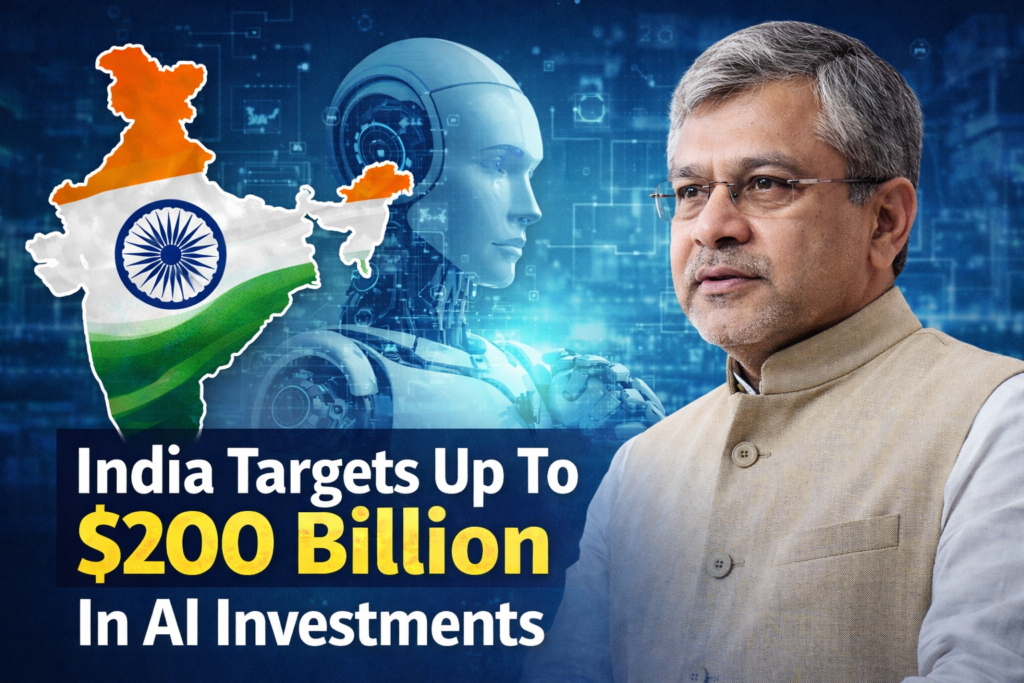
AI investments — India expects to attract up to $200 billion in investments in data centers over the next few years as it expands its goals to become an artificial intelligence hub, the country’s electronics and information technology minister said Tuesday.
These investments reflect tech giants’ reliance on India as a key technology and talent base in the global race for AI dominance. For New Delhi, they bring high-value infrastructure and foreign capital to a level that can accelerate its digital transformation goals.
The move comes at a time when governments around the world are grappling with job disruptions, regulations, and the increasing concentration of computing power in a few wealthy countries and companies.
“Today, India is being seen as a trusted AI partner for the Global South, seeking open, affordable, and development-focused solutions,” Ashwini Vaishnav told The Associated Press in an email interview. This comes as New Delhi is hosting a major AI Impact Summit this week, attended by at least 20 global leaders and tech industry experts.
In October, Google announced plans to invest $15 billion in India over the next five years to build its first artificial intelligence center in the South Asian country. Two months later, Microsoft announced Asia’s largest investment of $17.5 billion over the next four years to advance India’s cloud and artificial intelligence infrastructure.
Amazon has also pledged to invest $35 billion by 2030 to expand its business in India, specifically targeting AI-driven digitization. These investments are part of a $200 billion investment pipeline that New Delhi expects to receive.
Vaishnav said India believes that artificial intelligence should have a measurable impact on a large scale, rather than remaining a high-end technology.
He said, “A reliable AI ecosystem will attract investment and accelerate adoption,” adding that building infrastructure is a key part of India’s strategy to capitalize on the benefits of AI.
The government recently announced long-term tax exemptions for data centers, hoping to provide policy certainty and attract global capital. Vaishnav said the government has already launched a shared computing facility with over 38,000 graphics processing units, or GPUs, allowing startups, researchers, and public institutions to access high-end computing without significant upfront costs.
He added, “AI shouldn’t be exclusive. It should be widely accessible.”
Alongside the infrastructure drive, India is supporting the development of sovereign-based AI models trained in Indian languages and local context. Vaishnav said that some of these models meet global benchmarks and rival large language models widely used for specific tasks.
India also wants to play a major role in shaping how AI is created and used globally, as the country doesn’t consider itself merely a “rule-maker or rule-taker,” but rather an active participant in setting practical, workable standards while expanding the reach of its AI services worldwide.
He said, “India will become a major provider of AI services in the future,” describing a strategy that is “self-reliant and globally integrated” across applications, models, chips, infrastructure, and energy.
Investor confidence is another important area for New Delhi, as global tech funding has become more cautious.
Vaishnav said that implementation is supporting the promotion of technology, pointing to the Indian government’s AI Mission program, which emphasizes sector-specific solutions through public-private partnerships.
Read also: Despite Epstein files toxic influence, Steve Bannon remained with him, texts reveal
The government is also betting on reskilling its workforce as concerns grow worldwide that AI could disrupt white-collar and technology jobs. The minister said that New Delhi University is expanding AI education through skilling programs and online platforms to create a large pool of AI-ready talent.
He said that widespread 5G connectivity across the country and a young, tech-savvy population are expected to help accelerate AI adoption.
However, striking a balance between innovation and security remains a challenge as AI expands into sensitive areas such as governance, healthcare, and finance.
Vaishnav outlined a four-fold strategy that includes an enforceable global framework, reliable AI infrastructure, regulation of harmful misinformation, and robust human and technological capabilities to mitigate impact.
“The future of AI must be inclusive, inclusive, and focused on development,” he said.