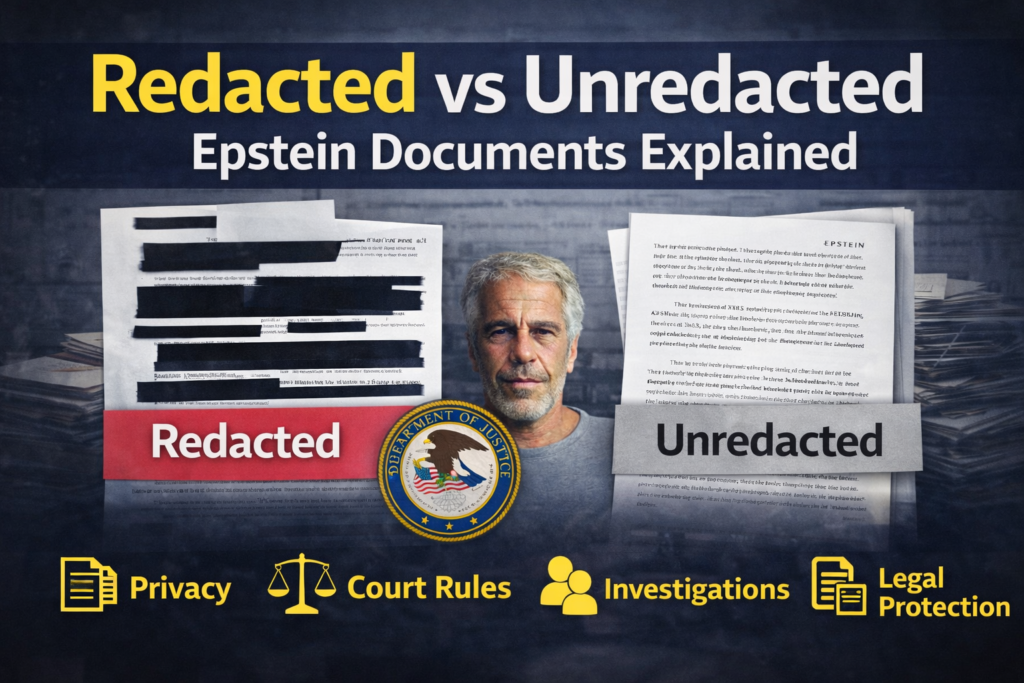
Redacted vs Unredacted Epstein Documents: The release of the Epstein Files has generated widespread public attention, particularly around the difference between redacted and unredacted documents. As thousands of court records, depositions, emails, and investigative materials were unsealed, many pages appeared with blacked-out sections — raising questions about transparency, privacy, and legal protections.
In this guide, we explain how redactions work, why certain information is withheld, and what the distinction between redacted and unredacted Epstein documents means in legal and investigative terms. For a broader contextual overview, see our full Epstein Files complete breakdown covering court records and global impact.
What Are Redacted Documents?
A redacted document is a file in which specific portions of text are intentionally concealed before public release. The concealed sections typically appear as black bars or blank spaces.
Redactions are commonly applied to:
- Names of private individuals
- Personal contact information
- Financial account details
- Minor identities
- Ongoing investigative materials
- Sensitive law enforcement techniques
In the context of the Epstein court records, redactions were implemented under federal court supervision to balance public transparency with privacy and legal protections.
Read also: Full Epstein court records analysis
What Are Unredacted Documents?
An unredacted document contains the full, original content without any information concealed.
Unredacted versions are typically:
- Submitted to the court
- Reviewed by judges
- Shared with legal teams
- Sealed unless ordered public
In certain phases of the Epstein document release, some previously redacted material became partially or fully unredacted after court review.
Why Were the Epstein Files Redacted?
Several legal and procedural factors influenced redactions in the Epstein Files document release.
1. Protection of Victims
Many filings contain sensitive information related to alleged victims. Federal courts often redact identifying details to prevent further harm.
2. Privacy of Third Parties
Some individuals mentioned in court filings were not charged with crimes. Courts frequently redact names to avoid reputational damage without due process.
3. Ongoing Investigations
At various stages, prosecutors and judges limited disclosures to prevent interference with parallel investigations.
4. Court Sealing Orders
Some documents were sealed under judicial authority and later partially unsealed with modifications.
Legal Process Behind Redactions
Redactions in federal cases typically follow this structured process:
- Motion filed to seal or redact material
- Judicial review of sensitive content
- Determination balancing public interest vs. privacy
- Release of approved redacted version
This process applied to many documents within the broader Epstein court records explained in our main breakdown.
Federal courts operate under transparency principles, but they also protect:
- Due process rights
- Fair trial standards
- Personal privacy
- Ongoing investigative integrity
What Changed in Later Epstein File Releases?
As litigation progressed, some redacted information was later unsealed.
Reasons included:
- Completion of investigations
- Expiration of protective orders
- Court rulings favoring public access
- Appeals decisions
However, not all redactions were removed. Many sections remain sealed due to legal restrictions.
Are Redactions Evidence of Hidden Information?
Redactions often generate speculation. However, in legal practice, redaction does not automatically indicate misconduct or concealment of wrongdoing.
Common misconceptions include:
- Assuming every redaction hides explosive information
- Believing courts redact only to protect powerful figures
- Confusing privacy protections with suppression
In reality, redaction is standard procedure in federal litigation.
Read also: Video evidence extracted from Epstein records
Redacted vs Unredacted: Key Differences
| Feature | Redacted Documents | Unredacted Documents |
|---|---|---|
| Public Accessibility | Released with concealed sections | Often sealed or limited |
| Privacy Protection | High | Limited |
| Investigative Sensitivity | Preserved | Fully visible |
| Legal Risk | Reduced | Greater |
Why Some Epstein Records Remain Sealed
Even after major disclosures, some Epstein legal documents remain sealed.
Possible reasons include:
- Grand jury confidentiality rules
- Minor victim protection
- National or international jurisdiction issues
- Pending civil litigation
Federal grand jury material, in particular, is protected under strict secrecy laws.
How Media and Researchers Analyze Redacted Files
Investigative journalists and legal analysts often:
- Cross-reference court filings
- Compare different versions of documents
- Analyze timeline inconsistencies
- Track judicial rulings on sealing motions
This methodical approach helps avoid misinterpretation.
Impact of Redactions on Public Understanding
Redactions can:
- Limit narrative clarity
- Create information gaps
- Encourage speculation
- Protect vulnerable individuals
The balance between transparency and privacy remains central to high-profile federal cases.
Read also: Steve Bannon texts revealed in Epstein documents
Frequently Asked Questions
Why are some Epstein documents fully unredacted?
Certain filings did not contain protected personal data or were approved for full public release.
Can redacted information ever become public?
Yes. Courts can later unseal previously redacted sections after legal review.
Are redactions permanent?
Not always. Some are permanent due to privacy law; others depend on future court rulings.
Does redaction mean someone is guilty?
No. Redaction is a procedural safeguard, not a determination of guilt.
Conclusion
Understanding the difference between redacted and unredacted Epstein documents is essential for interpreting the broader Epstein Files responsibly. Redactions reflect judicial balancing between transparency and legal protections — not necessarily concealment.
As additional filings are reviewed and court decisions evolve, more clarity may emerge. For a comprehensive analysis of court records, document releases, and global implications, refer to our full Epstein document release analysis.
Read more: Epstein Files Transparency Act – Production of Department Materials