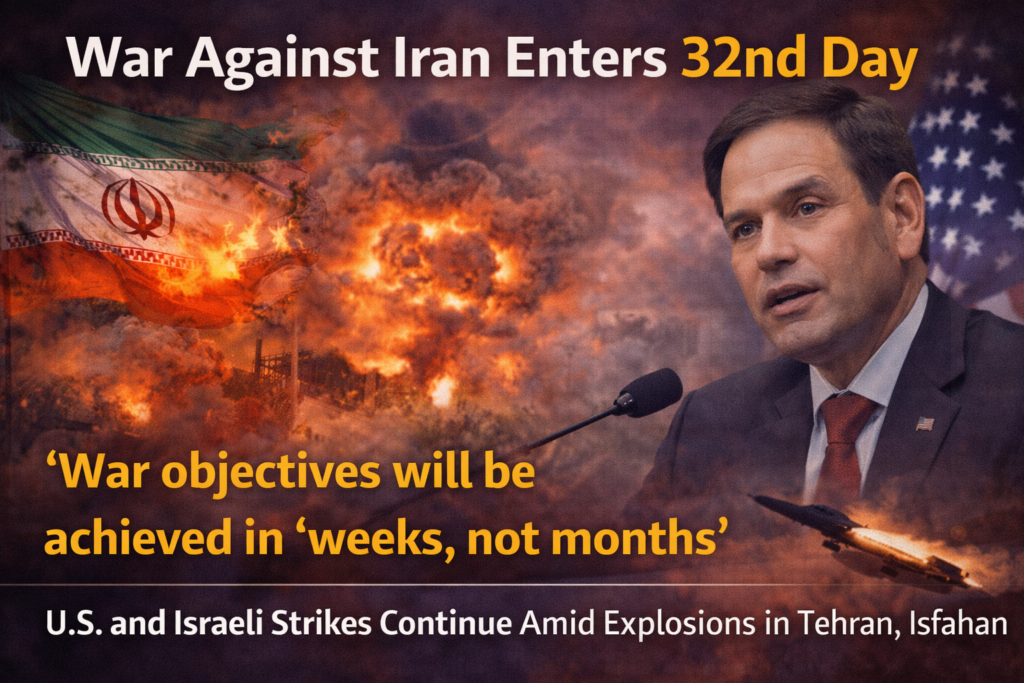
As the war against Iran enters its 32 day, U.S. and Israeli airstrikes continue across the country, with reports of violent explosions in Tehran and Isfahan.
In an exclusive interview with Al Jazeera, U.S. Secretary of State Marco Rubio stated that communications between Tehran and Washington remain active—conducted primarily through intermediaries—and added that U.S. war objectives would be achieved in a matter of “weeks, not months.”
Meanwhile, U.S. President Donald Trump has threatened to destroy Iran’s main oil export hub, as well as its energy infrastructure, unless an agreement is reached in the very near future.
Join our social media platform
WhatsApp Channel
Join Now
Telegram Group
Join Now
Facebook
Follow Now
In Iran
- State media reported that a parliamentary committee has approved the imposition of transit fees on vessels passing through the Strait of Hormuz—a vital corridor for oil and gas transport where maritime traffic has come to a virtual standstill due to the war.
- Trump threatened to destroy Kharg Island—a major Iranian hub for oil exports—as well as oil wells and power plants, unless an agreement is reached in the very near future.
- Israel and the United States continued their bombing campaigns; reports indicate that loud explosions were heard in both Tehran and Isfahan.
- Mohamed Fall, an Al Jazeera correspondent, stated that Iranian leaders are focusing their entire attention on the war effort, given their deep mistrust of the United States; they perceive that Washington is not truly willing to engage in negotiations aimed at ending the war.
- The Iranian Navy launched its latest wave of regional attacks, marking the eighty-seventh such strike in a single month. Fall explained that these attacks serve as a “very forceful message directed at the United States,” demonstrating the falsity of Washington’s claims to have neutralized Iran’s naval forces.
- For its part, the Islamic Revolutionary Guard Corps confirmed the death of its naval commander, Admiral Alireza Tangsiri, who was recently killed in an Israeli airstrike.
War diplomacy
- Talks between Pakistan and China: Pakistan’s Deputy Prime Minister and Foreign Minister, Ishaq Dar, is visiting Beijing this Tuesday to hold talks with Chinese Foreign Minister Wang Yi. This visit follows meetings Dar held over the weekend in Islamabad with senior diplomats from Saudi Arabia, Turkey, and Egypt.
- G7 Ministers Pledge Energy Measures: The economic and finance ministers of the Group of Seven (G7)—the world’s leading industrialized nations—have declared that they are prepared to take “all necessary measures” to stabilize the energy market.
- Sisi Asks Trump for Help to Stop the War: In remarks made in Cairo, President Abdel Fattah el-Sisi stated: “I say to President Trump: no one else can stop the war in our region—and in the Gulf. Please, help us stop the war; you have the power to do so.”
- NATO Intercepts Missile Heading Toward Turkey: NATO forces have intercepted a missile fired from Iran and heading toward Turkey. This marks the fourth interception of such a missile since the outbreak of war in the Middle East region.
In the Gulf Region
- Attack on Kuwaiti Oil Tanker: Iran has launched a “direct and criminal” attack against the Kuwaiti oil tanker Al-Salmi—a fully loaded vessel that was docked at the port of Dubai.
- Missiles Intercepted in Saudi Arabia: Saudi Arabia has announced that it intercepted at least eight ballistic missiles targeting the capital, Riyadh, as well as the energy-rich Eastern Province.
- Gulf Leaders Condemn Escalation: During a summit held in Jeddah, the leaders of Saudi Arabia, Qatar, and Jordan jointly condemned the Iranian attacks targeting vital civilian infrastructure. Regional Warnings: The escalating repercussions of the conflict have placed neighboring nations on high alert; Bahrain, for instance, activated its air-raid sirens and urged residents to immediately seek shelter in the nearest safe location.
- Araqchi Calls for “Expulsion of U.S. Forces” from the Region: Iranian Deputy Foreign Minister Abbas Araqchi declared that “the time has come” for U.S. forces to vacate their bases scattered across the Gulf states.
In the United States
- Senator Rubio told Al Jazeera that a significant portion of the communications currently taking place between Tehran and Washington is being conducted indirectly, through intermediaries. Nevertheless, the exchange of messages—along with some direct contacts—remains ongoing.
- Rubio added that the waterways would remain open, regardless of Iran’s actions.
- For his part, the Secretary of State stated that U.S. war objectives could be achieved “in a matter of weeks, not months,” noting that operations are proceeding as planned following the destruction of the Iranian Air Force and a large segment of its naval fleet.
- More than 200 U.S. soldiers have filed formal complaints regarding the use of religious rhetoric by their commanding officers to justify the war. The U.S. State Department publicly expressed its support for Israel following the ratification by the Israeli Parliament of a law authorizing the execution of Palestinians convicted of carrying out deadly attacks.
Read also: Despite Epstein file toxic influence, Steve Bannon remained with him, texts reveal
In Israel
- Israeli Prime Minister Benjamin Netanyahu declared on Monday that the war against Iran has achieved more than half of its objectives, although he did not specify a timeframe for its conclusion.
- The Israeli military announced that it carried out an attack against Imam Hossein University in Tehran—which is operated by the Iranian Revolutionary Guard—alleging that the institution was being used for advanced weapons research.
- Furthermore, a massive fire broke out at the Haifa oil refinery in Israel after it was struck on Monday by fragments resulting from the interception of an aerial projectile.
In Lebanon and Iraq
- UN Peacekeepers Killed in Lebanon: The United Nations Interim Force in Lebanon (UNIFIL) announced on Monday the deaths of two of its personnel due to an explosion in the south of the country, just one day after another peacekeeper lost their life.
- Drone Attack on U.S. Embassy in Baghdad: A police source reported that a civilian was injured late Monday in the Iraqi capital after shrapnel—from an intercepted drone attack targeting the embassy—fell into their residential neighborhood.
Oil, Food, and Fuel Crisis
- Sharp Rise in Oil Prices: The ongoing conflict is directly impacting the U.S. economy; the price of West Texas Intermediate (WTI)—the U.S. benchmark crude—has breached the $100-per-barrel mark for the first time since 2022. Furthermore, the average price of gasoline at service stations has exceeded $4 per gallon, also for the first time since the outbreak of Russia’s war against Ukraine.
- Norway Cuts Fuel Taxes: Norway plans to temporarily reduce its taxes on gasoline and diesel in an effort to combat rising prices, amidst global energy supply disruptions triggered by the war in the Middle East.
- Bangladesh Orders Energy-Saving Measures: Bangladesh has issued directives requiring government employees to turn off lights and reduce air conditioning levels in an effort to conserve electricity, as the country’s energy crisis worsens due to the repercussions of the war.
Read More
- NDTV India is Hindi News Website. Read Hindi News, Latest Hindi News, Today Hindi News, Breaking Hindi News, Hindi Samachar
- Today’s news: Get latest and Breaking News on Politics, Business, Lifestyle, Entertainment and Sports along with News updates from around the world.
- Read the Latest News Updates online related to India, World and US business and economy.
- Times of India: News – Breaking News, Latest News, India.
- ભારતની તમામ નવી સરકારી યોજનાઓ 2026 વિશે માહિતી