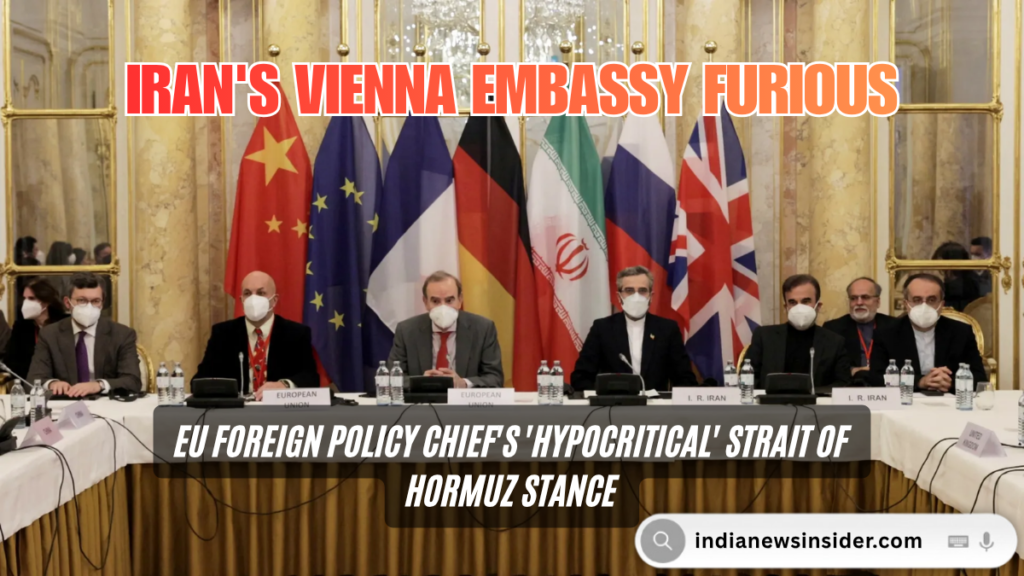
Iran EU foreign policy stance: The intricate and often fraught relationship between Iran and the European Union has once again been thrust into the spotlight, following a blistering attack from Iran’s embassy in Vienna against EU foreign policy chief Kaja Kallas. This diplomatic broadside, focusing on Kallas’s remarks concerning the Strait of Hormuz, underscores the deep-seated mistrust and divergent perspectives that continue to define the Iran EU foreign policy stance.
The embassy’s accusations of hypocrisy and a perceived bias in international discourse reveal the complexities of navigating geopolitical tensions in a region vital to global commerce and energy security.
The incident serves as a potent reminder of the delicate balance the EU attempts to strike between its commitment to international law and human rights, and its strategic interests in engaging with a significant, albeit controversial, regional power like Iran.
Join our social media platform
This sharp exchange is not merely a war of words but a reflection of fundamental disagreements on issues ranging from maritime security and nuclear proliferation to regional stability and the interpretation of international conventions. Understanding the nuances of this latest confrontation requires a comprehensive look at the specific allegations, the strategic importance of the Strait of Hormuz, and the broader context of Iran EU foreign policy stance.
The Catalyst: Kaja Kallas’s Call for “Toll-Free Freedom of Navigation”
The spark for this diplomatic firestorm was ignited by comments made by EU foreign policy chief Kaja Kallas during a meeting with Chinese Foreign Minister Wang Yi. Kallas emphasized that restoring “toll-free freedom of navigation” in the Strait of Hormuz was an “urgent priority.” Her remarks were framed in the context of recent attacks on civilian ships, which she attributed to Iran, claiming these actions had brought maritime traffic in the vital waterway to a near halt.
Kallas’s statement, delivered on a global stage, was clearly intended to convey the EU’s concern over disruptions to international shipping and its commitment to the principles of free navigation. For the EU, a stable and predictable flow of goods, particularly energy resources, through key global chokepoints like the Strait of Hormuz, is paramount for its economic well-being and strategic interests.
Her direct attribution of blame to Iran, however, was perceived by Tehran as a biased and unjust condemnation, failing to acknowledge what Iran views as the full spectrum of regional aggressions and provocations. The specific mention of “toll-free” navigation also touches upon historical grievances and Iran’s long-standing claims regarding its sovereign rights within its territorial waters. This specific aspect further complicated the Iran EU foreign policy stance on maritime law.
Iran’s Fiery Retort: Accusations of Hypocrisy and Legal Challenges
In a swift and uncharacteristically scathing response, Iran’s embassy in Austria unleashed a series of posts, directly challenging Kallas’s narrative and integrity. The embassy’s retort was not merely defensive but aggressively accusatory, painting Kallas as either misinformed or deliberately biased. This strong reaction highlights Iran’s sensitivity to external criticism, particularly when it pertains to its national security and regional role, significantly impacting the Iran EU foreign policy stance.
Allegations of a Double Standard: The “American-Israeli Evil Coalition”
At the heart of the embassy’s counter-argument was the accusation of a profound double standard. It asserted that Kallas was “ignoring the aggressive attacks by the American-Israeli evil coalition against Iran” while simultaneously condemning what it termed Tehran’s “purely defensive actions.” This framing is crucial to understanding Iran’s worldview.
From Tehran’s perspective, its actions in the Strait of Hormuz and elsewhere are often reactive, a response to what it perceives as continuous acts of aggression, sabotage, and destabilization orchestrated by its adversaries, primarily the United States and Israel.
The embassy’s statement implies that Kallas, and by extension the EU, selectively applies international law and moral principles. Iran frequently points to cyberattacks, assassinations of its nuclear scientists, and economic sanctions as acts of undeclared war or aggression that destabilize the region and threaten its sovereignty.
When the EU criticizes Iran’s responses without acknowledging these preceding actions, Iran views it as a fundamental injustice and a demonstration of Western hypocrisy. This deep-seated grievance is a constant undercurrent in any discussion regarding the Iran EU foreign policy stance.
The Legal Challenge: UNCLOS and Iran’s Non-Partisanship
Adding a layer of legal contention to the diplomatic spat, the Iranian embassy challenged Kallas on her invocation of the UN Convention on the Law of the Sea (UNCLOS). Kallas had urged Iran to respect the treaty, prompting the embassy to point out a critical detail: Iran is not a party to UNCLOS. This detail, while seemingly technical, carries significant weight in international law and diplomatic discourse.
The embassy’s question, “What kind of advisors surround her? A batch of spineless “yes-men” puppets, no different from the sycophants who surround Trump?” was a direct and personal attack on Kallas’s competence and the quality of her counsel.
By highlighting Iran’s non-ratification of UNCLOS, the embassy suggested that Kallas’s admonition was legally unsound or, at best, ill-informed. While many of UNCLOS’s provisions are considered customary international law and are widely respected even by non-signatories, Iran’s formal non-partisanship gives it a rhetorical edge to push back against direct demands based solely on the convention.
This specific point aimed to undermine the legitimacy of the EU’s position and further complicate the Iran EU foreign policy stance on maritime governance.
The Nuclear Program Context: NPT and “Peaceful, Safeguarded Facilities”
In a move to further illustrate what it sees as international hypocrisy, the embassy also brought up Iran’s nuclear program. It stated that Iran had honored the Nuclear Non-Proliferation Treaty (NPT), yet its “peaceful, safeguarded nuclear facilities were still attacked.” This reference is deeply embedded in Iran’s narrative of victimhood and unfair treatment on the international stage.
Iran maintains that its nuclear program is for peaceful purposes, consistent with its NPT obligations, and subject to IAEA safeguards. However, its program has been a source of intense international concern, leading to crippling sanctions and accusations of developing nuclear weapons capabilities.
By highlighting attacks on its facilities, Iran draws a parallel to the perceived double standard: it adheres to a treaty, yet its infrastructure is targeted, while others who may not adhere to similar norms (implicitly referring to Israel’s undeclared nuclear arsenal) face no such scrutiny. This element of the response is crucial for understanding the historical grievances that shape the broader Iran EU foreign policy stance.
The Strategic Importance of the Strait of Hormuz
To fully grasp the significance of this diplomatic row, it is essential to understand why the Strait of Hormuz is such a flashpoint. This narrow waterway, connecting the Persian Gulf with the Arabian Sea and the Indian Ocean, is one of the world’s most critical maritime chokepoints.
Global Energy Lifeline
Approximately one-fifth of the world’s total oil consumption, and a significant portion of liquefied natural gas (LNG), passes through the Strait of Hormuz. It is the primary transit route for oil exports from Saudi Arabia, Iran, Iraq, Kuwait, Qatar, and the UAE. Any disruption to traffic in the Strait sends immediate shockwaves through global energy markets, impacting prices and supply chains worldwide.
For energy-dependent regions like Europe, ensuring uninterrupted passage is not merely an economic concern but a matter of national security. The EU’s reliance on global energy markets makes the stability of this region a core component of its Iran EU foreign policy stance.
Historical Tensions and Geopolitical Significance
The Strait has been a locus of geopolitical tension for decades. During the Iran-Iraq War in the 1980s, both sides attacked tankers in what became known as the “Tanker War.” More recently, incidents involving the seizure of tankers, attacks on shipping, and heightened naval presence by various international forces have underscored its volatility.
Iran views the Strait as integral to its national security and a potential leverage point in its confrontations with the West. Its ability to influence or threaten navigation through the Strait is a powerful, albeit risky, tool in its foreign policy arsenal. This historical context is vital when analyzing the Iran EU foreign policy stance on maritime security.
Iran’s Perspective on Security and Sovereignty
Iran maintains that it has a legitimate right to protect its territorial waters and ensure security in the Strait, particularly given its extensive coastline along the waterway. It views foreign military presence, especially that of the United States, as provocative and destabilizing. Tehran often frames its actions as necessary measures to deter aggression and safeguard its interests in a hostile regional environment.
This narrative clashes directly with the EU’s emphasis on “toll-free freedom of navigation,” leading to an intractable disagreement over the interpretation of international maritime law and sovereign rights, thereby shaping the Iran EU foreign policy stance.
The Broader Context of EU-Iran Relations
This latest spat is not an isolated incident but rather a symptom of the deeply troubled relationship between the EU and Iran, a relationship complicated by a myriad of factors.
The Shadow of the JCPOA
The 2015 Joint Comprehensive Plan of Action (JCPOA), or Iran nuclear deal, represented a brief period of rapprochement between Iran and major world powers, including the EU. However, the US withdrawal from the deal in 2018 and the subsequent re-imposition of sanctions severely undermined the agreement and the EU’s efforts to preserve it.
The EU has consistently expressed its commitment to the JCPOA, viewing it as a cornerstone of non-proliferation, even as Iran has progressively scaled back its commitments in response to sanctions. The failure to fully revive the JCPOA has cast a long shadow over the Iran EU foreign policy stance, making broader cooperation extremely difficult.
Sanctions and Economic Pressure
The extensive sanctions regime, primarily led by the US but often impacting European businesses, has crippled Iran’s economy. While the EU has attempted to maintain channels for legitimate trade and humanitarian aid, the threat of secondary sanctions has largely deterred European companies from engaging significantly with Iran.
This economic pressure is a constant source of resentment in Tehran, which views it as collective punishment and an attempt to destabilize its regime. The economic dimension significantly influences the Iran EU foreign policy stance, as the EU seeks to balance its values with pragmatic engagement.
EU’s Balancing Act
The EU faces a complex balancing act. On one hand, it seeks to uphold international law, promote human rights, and prevent nuclear proliferation. On the other hand, it recognizes Iran as a significant regional actor whose stability or instability profoundly impacts the Middle East and, by extension, Europe.
This often leads to a policy of critical engagement, where the EU condemns certain Iranian actions while simultaneously seeking dialogue on areas of mutual concern. Kallas’s statements reflect this dual approach, attempting to assert European principles while acknowledging the need for engagement, albeit with different interpretations from the Iranian side on the Iran EU foreign policy stance.
Geopolitical Implications and Future Challenges
The sharp exchange between Iran’s Vienna embassy and EU foreign policy chief Kaja Kallas carries significant geopolitical implications, extending beyond the immediate diplomatic friction.
US-Iran Dynamics
The incident cannot be divorced from the broader US-Iran rivalry. Iran’s reference to the “American-Israeli evil coalition” underscores its perception that Kallas’s remarks align with the narrative pushed by its primary adversaries. Any European stance on Iran is invariably viewed through the prism of its relationship with the United States, further complicating the EU’s independent foreign policy aspirations and affecting the overall Iran EU foreign policy stance.
China’s Role
Kallas’s initial remarks were made during a meeting with China’s Foreign Minister. China, a major consumer of Middle Eastern oil, has a vested interest in the stability of the Strait of Hormuz. While China generally advocates for de-escalation and dialogue, its growing economic and strategic presence in the region adds another layer of complexity. The EU’s engagement with China on issues related to Iran also highlights the increasing multipolarity of international relations.
Regional Instability
The ongoing diplomatic skirmishes contribute to an already volatile regional environment. Tensions in the Persian Gulf, the Red Sea, and wider Middle East are interconnected. Escalating rhetoric, particularly concerning critical chokepoints like the Strait of Hormuz, risks miscalculation and further destabilization. The challenge for the EU and other international actors is to find pathways to de-escalation and dialogue, even amidst profound disagreements, to prevent regional conflicts from spiraling out of control. This requires a very careful and nuanced Iran EU foreign policy stance.
The Future of Diplomacy
The aggressive tone adopted by the Iranian embassy, questioning Kallas’s advisors and integrity, signifies a hardening of diplomatic rhetoric. This approach, while perhaps satisfying a domestic audience in Iran, makes constructive dialogue more challenging. For the EU, maintaining its principles while seeking pragmatic engagement with Iran will remain a formidable task. The episode underscores the difficulty of forging a unified and effective Iran EU foreign policy stance when fundamental disagreements on facts, history, and international law persist.
Conclusion: A Deepening Divide in the Iran EU Foreign Policy Stance
The fierce rebuke from Iran’s Vienna embassy to EU foreign policy chief Kaja Kallas is more than just a diplomatic spat; it is a stark illustration of the deep chasm that defines the Iran EU foreign policy stance. Iran views Kallas’s condemnation of its actions in the Strait of Hormuz as hypocritical, ignoring what it perceives as aggressive provocations from its adversaries and misrepresenting its defensive posture. The legal challenge regarding UNCLOS and the contextualization of its nuclear program further solidify Iran’s narrative of being unfairly targeted and misunderstood on the global stage.
For the European Union, the incident highlights the enduring challenge of asserting its foreign policy principles – particularly regarding maritime security and international law – while navigating the complex realities of engaging with a nation like Iran, which holds a vastly different interpretation of regional events and international norms. The Strait of Hormuz remains a critical artery for global trade, and the stability of the region is paramount for international security. However, achieving this stability requires a mutual understanding and a willingness to acknowledge diverse perspectives, something that appears increasingly difficult to achieve in the current climate.
As the geopolitical landscape continues to shift, the Iran EU foreign policy stance will remain a crucial barometer of broader international relations. This latest confrontation serves as a powerful reminder that without addressing the underlying grievances, historical contexts, and perceived double standards, the path towards constructive engagement between Iran and the EU will remain fraught with tension and diplomatic flashpoints. The need for clear, consistent, and equitable international diplomacy has never been more pressing, yet the ability to deliver it appears increasingly elusive.
Read More
- NDTV India is Hindi News Website. Read Hindi News, Latest Hindi News, Today Hindi News, Breaking Hindi News, Hindi Samachar
- Today’s news: Get latest and Breaking News on Politics, Business, Lifestyle, Entertainment and Sports along with News updates from around the world.
- Read the Latest News Updates online related to India, World and US business and economy.
- Times of India: News – Breaking News, Latest News, India.
- ભારતની તમામ નવી સરકારી યોજનાઓ 2026 વિશે માહિતી