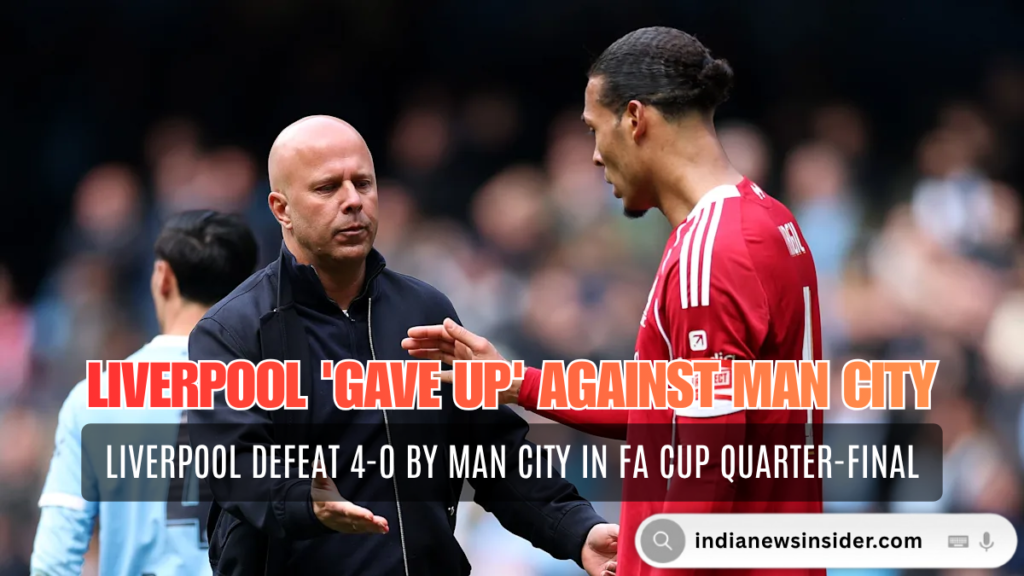
Liverpool’s Humiliating Surrender in the FA Cup quarter-final against Manchester City has sent shockwaves through the club, with captain Virgil van Dijk delivering a scathing assessment of his team’s performance. The Reds succumbed to a brutal 4-0 defeat at the Etihad Stadium, a result that not only extinguished their hopes of domestic silverware but also prompted a stark admission from their leader: the team “gave up.” This crushing loss, Liverpool’s 15th of a disjointed season, has intensified pressure on manager Arne Slot and left fans questioning the very fabric of the team’s renowned fighting spirit.
Join our social media platform
The aftermath saw a visibly disappointed Van Dijk apologise to the supporters, the manager, and his teammates, highlighting a collective failure that cut deep. Erling Haaland’s hat-trick, complemented by a goal from Antoine Semenyo, underscored City’s dominance, while a penalty save from Mo Salah further compounded Liverpool’s misery. This article delves into the details of this calamitous match, the captain’s candid remarks, the tactical shortcomings, and the profound implications for Liverpool’s challenging season ahead.
The Crushing Reality of Liverpool’s Humiliating Surrender
The FA Cup quarter-final clash at the Etihad was billed as a pivotal moment for Liverpool, a chance to salvage pride and potentially a trophy from what has largely been a disappointing campaign. Instead, it unfolded into a nightmare, culminating in a resounding 4-0 defeat that exposed deep-seated issues within the squad. From the outset, the stakes were high, but the outcome was a stark reminder of the gap that currently exists between Liverpool and their perennial rivals, Manchester City.
The game began with a semblance of parity, an evenly-matched opening half-hour where both teams probed and tested. However, this fragile balance was shattered when Liverpool captain Virgil van Dijk committed a foul on Nico O’Reilly inside the box. Erling Haaland, ever the clinical finisher, dispatched the resulting penalty, opening the floodgates. What followed was a devastating 18-minute spell that spanned the interval, during which City struck four times, sealing Liverpool’s fate with brutal efficiency.
Haaland went on to complete a hat-trick, showcasing his predatory instincts, while Antoine Semenyo added to Liverpool’s woes. The final whistle confirmed not just a defeat, but a humiliating rout, leaving Liverpool to grapple with the bitter taste of an early FA Cup exit.
The immediate reaction was one of disbelief and profound disappointment. For a club synonymous with resilience and an unwavering will to win, the manner of the defeat was particularly galling. Van Dijk, a figure known for his composure and leadership, did not shy away from the harsh truth, his words painting a picture of a team that had lost its way on the pitch.
His apology to the fans was not merely a formality; it was an acknowledgment of a performance that fell far short of the standards expected of Liverpool Football Club. This was truly a Liverpool’s Humiliating Surrender on a grand stage.
Read also: Flick Clarifies Lamine Yamal’s Post-Match Anger After Crucial Barcelona Victory
A Captain’s Stark Admission: “We Let Ourselves Down”
In the immediate aftermath of the 4-0 thrashing, Liverpool captain Virgil van Dijk did not mince words. His post-match interview was a raw and honest assessment, placing the blame squarely on the players’ shoulders, and offering a heartfelt apology to the club’s loyal fanbase. “I can only apologise to the fans for what we have shown, especially the second half,” Van Dijk stated, his voice heavy with disappointment. This sentiment resonated deeply, as the second half indeed saw a complete unraveling of Liverpool’s defensive and mental resolve.
Van Dijk recounted the team’s intentions coming out for the second half: “Obviously you come out with the right intentions from the dressing room, to hopefully score for 2-1 as soon as possible to change the game.” However, the reality was starkly different.
“The opposite happens and to come back from 3-0 is obviously very difficult here – but also you shouldn’t give up and that’s maybe, at a certain point, what happened.” This admission of “giving up” is perhaps the most damning indictment, striking at the core of Liverpool’s identity under manager Arne Slot. It suggests a fundamental crack in the team’s mentality, a surrender of belief when faced with adversity.
The captain’s words extended beyond the fans, encompassing the entire Liverpool ecosystem. “We let our fans down, we let ourselves down, and the manager,” he confessed. The weight of responsibility was palpable in his tone. “The way we played in the second half, especially, must hurt for everyone. It definitely hurts me.”
This deeply personal expression of pain underscores the gravity of the situation and highlights the emotional toll such a performance takes on the players themselves. For Van Dijk, who has been a pillar of strength and consistency for years, witnessing such a capitulation was clearly a source of immense anguish. The collective feeling was undeniably one of Liverpool’s Humiliating Surrender.
Tactical Capitulation: How the Collapse Unfolded
The tactical breakdown during Liverpool’s FA Cup quarter-final defeat to Manchester City was as alarming as the final scoreline. While the initial thirty minutes saw an evenly contested battle, the subsequent collapse was rapid and total, transforming a competitive fixture into a one-sided rout. The pivotal moment arrived with Van Dijk’s foul on Nico O’Reilly, leading to Haaland’s opening penalty. This single incident seemed to shatter Liverpool’s fragile composure, initiating a chain reaction of errors and a complete loss of defensive structure and attacking impetus.
After Haaland’s opener, the visitors’ resistance crumbled with astonishing speed. City, sensing their opponents’ vulnerability, capitalized ruthlessly, orchestrating a “devastating 18-minute spell” that effectively ended the contest. The speed and precision of City’s attacks contrasted sharply with Liverpool’s increasingly disjointed efforts.
The midfield struggled to cope with City’s intricate passing and movement, while the defence, often left exposed, found itself overwhelmed by Haaland’s relentless threat and the creativity of City’s wide players. The absence of Alisson Becker due to injury further exacerbated the defensive woes, as his commanding presence and shot-stopping prowess were sorely missed. This was a complete and utter Liverpool’s Humiliating Surrender on all tactical fronts.
The issues were not confined to the defence. Liverpool’s attack, despite having 36 touches in the opposition penalty box compared to City’s 21, failed to convert these opportunities into meaningful chances or goals. Mo Salah’s missed penalty, following Haaland’s successful spot-kick, felt symbolic of the team’s struggles in crucial moments.
The attack lacked the clinical edge and cohesion required to trouble a top-tier defence like City’s. This inability to capitalize on attacking forays while simultaneously being vulnerable at the back formed a devastating combination, illustrating a team that was fundamentally out of sync.
The Mental Fortitude Gap: Szoboszlai and Slot Weigh In
The tactical disarray was compounded by a significant mental fortitude gap, a point echoed by both midfielder Dominik Szoboszlai and manager Arne Slot. Szoboszlai, reflecting on the team’s inability to recover from setbacks, claimed his teammates “lacked the mentality” required to bounce back. This is a damning indictment for a team that, in its prime, was known for its ‘mentality monsters’ tag, capable of turning games around from seemingly impossible positions. The current squad, it appears, struggles to find that inner resolve when faced with adversity.
Manager Arne Slot concurred with this assessment, acknowledging that the team’s reaction to Haaland’s opening goal was “not good enough.” Slot’s analysis points to a crucial area of concern: the psychological resilience of the squad. In high-stakes matches, particularly against a team of Manchester City’s caliber, conceding a goal can be a turning point.
For Liverpool, it proved to be a breaking point. The immediate response should have been one of increased intensity, focus, and determination to claw their way back into the game. Instead, the team visibly sagged, their confidence seemingly evaporating with each subsequent City goal.
This lack of mental resilience has been a recurring theme throughout Liverpool’s season. While they have shown flashes of brilliance, particularly in moments of individual skill, the collective ability to withstand pressure and recover from errors has been inconsistent. The Etihad defeat brought this vulnerability into sharp focus, highlighting a critical area that Slot and his coaching staff must address.
Building mental toughness and instilling an unwavering belief, even when circumstances are dire, will be paramount if Liverpool are to navigate the remainder of their challenging season and avoid further instances of Liverpool’s Humiliating Surrender.
The Shadow of PSG: Intensified Pressure and Future Challenges
The dismal defeat at the Etihad has cast a long and ominous shadow over Liverpool’s immediate future, particularly with a daunting Champions League quarter-final trip to Paris Saint-Germain looming large.
The timing of such a comprehensive loss could not be worse, intensifying the pressure on manager Arne Slot and his squad as they prepare to face one of Europe’s elite teams. The psychological scars from the City game will need to heal rapidly, a significant challenge given the short turnaround and the magnitude of the upcoming European fixture.
Van Dijk, ever the pragmatist, acknowledged the collective responsibility in the face of these challenges. “It’s a together thing, isn’t it? Obviously he’s responsible as the manager but we are the ones on the pitch that have to do it,” he stated, reinforcing the idea that the players must bear the brunt of the performance.
He also highlighted the immediate need to shift focus: “The matter of fact is now, PSG are waiting for us. I watched them Friday a little bit. It will be so tough again. So we have to be ready mentally as soon as possible.” This urgency speaks volumes about the mental hurdle Liverpool must overcome before even stepping onto the pitch against PSG.
The captain also touched upon a broader issue facing the club: a period of “transition.” “I’ve been lucky enough to play for Liverpool for so many years. The main thing we always had was togetherness. Now obviously we are in a little bit of a transition, we have to find it,” Van Dijk explained. This insight suggests that the current squad is grappling not just with tactical or form issues, but with a fundamental shift in its collective identity and cohesion.
The renowned ‘togetherness’ that defined previous successful Liverpool teams appears to be wavering, making consistent high-level performance a significant struggle. The lack of this foundational unity makes it “difficult to perform every two days if you don’t have it consistently,” as Van Dijk candidly admitted. Overcoming this period of Liverpool’s Humiliating Surrender will require more than just tactical adjustments; it demands a rebuilding of spirit.
Navigating a Season of Disappointment: Champions League Hopes Fading
Liverpool’s struggles extend beyond the FA Cup, casting a significant doubt over their hopes of securing Champions League football for next season. The consistent underperformance, punctuated by demoralizing defeats like the one at the Etihad, has left their Premier League standing precarious.
For a club that has become accustomed to competing at Europe’s top table, missing out on the Champions League would be a severe blow, both financially and in terms of attracting top talent.
The fixture list offers no respite. Sandwiched between their two crucial Champions League quarter-final legs against Paris Saint-Germain is a vital Premier League match against Fulham. This game takes on heightened importance, as every point becomes critical in the race for a top-four finish.
Dropping points against Fulham could further jeopardize their European aspirations, adding another layer of pressure to an already strained squad. The ability to compartmentalize and perform consistently across different competitions, a hallmark of successful teams, is currently eluding Liverpool.
Van Dijk’s call to action reflects the gravity of the situation. “We have a responsibility to ourselves and, especially, to the fans. If we want to make something out of this season, then we have to try and produce something special the next three games,” he urged. This plea underscores the desperation to salvage something tangible from an otherwise disappointing season.
The captain’s candid admission that the team has “been going through this almost 75 per cent of the season” highlights the pervasive nature of their struggles. “We fall back into games where we get beaten on intensity or beaten on how much you really want to go for it. It’s a difficult one to take and everyone has to look at themselves.” This self-reflection is crucial, as the team must collectively confront its shortcomings to avoid further instances of Liverpool’s Humiliating Surrender.
Deeper Dive into Liverpool’s Humiliating Surrender: Adam Bate’s Analysis
Sky Sports’ Adam Bate’s analysis, “Slot’s worst defeat yet,” provided a piercing insight into the underlying issues plaguing Liverpool, dissecting the true nature of their 4-0 FA Cup defeat to Manchester City. On the surface, the statistics might offer a misleading sense of an even contest: shared possession, 11 attempts on goal for both teams, and Liverpool even boasting 36 touches in the opposition penalty box compared to City’s 21. However, as Bate astutely points out, these numbers belie the harsh reality of a team fundamentally flawed in critical areas.
“An even contest, then? Not quite,” Bate asserts. He argues that while the statistics might reveal City’s advantage in boasting “the best out-and-out striker on the planet” in Erling Haaland, they also expose what has consistently undermined Liverpool’s season: their profound weakness “in both boxes.” This inability to be decisive in front of goal and resolute in defence has been a recurring Achilles’ heel. The “details continue to cost them,” a sentiment echoed by the specific instances that turned the tide against them at the Etihad.
The critical errors were glaring. Van Dijk’s unnecessary foul on O’Reilly inside the box gifted City the opening goal, a moment of individual misjudgment from a player usually renowned for his defensive acumen. Mo Salah’s subsequent missed penalty, placed on the exact same spot from which Haaland had scored, felt like a cruel twist of fate, amplifying the sense of missed opportunities. Salah had also squandered the game’s first clear chance, underscoring a broader issue of profligacy.
The analysis further highlights the impact of key absences and underperformances. With Alisson Becker injured again, Liverpool lacked a crucial figure in goal, a leader who often bails out defensive errors. Florian Wirtz, their record signing, has “decorated too many of these big matches rather than dominate them,” suggesting a lack of consistent impact in crucial moments.
Furthermore, Bate points to a loss of quality at full-back and an imbalance in midfield, areas that were once the bedrock of Liverpool’s high-intensity, pressing game. The entire team seems to be suffering from a collective Liverpool’s Humiliating Surrender to their own flaws.
The Recurring Flaws: Intensity, Mentality, and Defensive Gaps
Adam Bate’s analysis delves deeper into the recurring flaws that have plagued Liverpool throughout the season, culminating in their FA Cup humiliation. He meticulously details how the team’s tactical approach and individual performances create vulnerabilities that opponents, particularly those of City’s calibre, are quick to exploit.
One significant issue Bate identifies is the disconnect between the attacking and defensive lines: “There were times when the forwards would push high while the defence would drop off, opening spaces that this Liverpool do not have the legs to cope with.” This tactical imbalance creates vast expanses in midfield, making Liverpool vulnerable to counter-attacks and intricate passing moves, forcing midfielders to cover immense ground.
The visual representation of this struggle comes with the observation of “Dominik Szoboszlai chasing shadows on his own,” a feature that has become all too common throughout the campaign. This image encapsulates the individual burden placed on players trying to compensate for systemic issues, highlighting a lack of cohesive pressing and defensive cover. The energy and intensity that were once Liverpool’s trademarks appear to be in short supply or, at best, inconsistently applied.
For all Liverpool’s struggles, Bate notes that “no team other than Manchester City has beaten them by more than the odd goal this season.” This statistic, while offering a semblance of competitiveness, ultimately makes the 4-0 defeat even more stark.
It suggests that while Liverpool can often grind out results or keep scores tight against most opponents, they buckle under the relentless pressure of a truly elite side. This particular defeat, Bate concludes, was “somehow different and yet also coming.” It wasn’t an anomaly but rather the culmination of persistent issues that had been brewing beneath the surface.
The “sort of excuses that supporters have had to listen to all year will not cover it now,” Bate argues, indicating that the time for self-justification is over. Van Dijk’s own reflection reinforces this point: “We fall back into games where we get beaten on intensity or beaten on how much you really want to go for it.”
This candid admission from the captain speaks volumes about a fundamental problem with the team’s application and drive, particularly when faced with adversity. The collective will to win, the unrelenting intensity, and the mental resilience that once defined Liverpool’s success have seemingly waned, leading to this profound Liverpool’s Humiliating Surrender.
Rebuilding from the Rubble: A Path Forward After Liverpool’s Humiliating Surrender
The 4-0 FA Cup defeat to Manchester City, and Virgil van Dijk’s subsequent admission of the team “giving up,” serves as a stark wake-up call for Liverpool. Rebuilding from this rubble requires a multi-faceted approach, addressing not just tactical shortcomings but also the mental and emotional fabric of the squad. The path forward demands introspection, decisive action, and a renewed commitment to the principles that once made Liverpool a formidable force.
Firstly, a critical assessment of the team’s mentality is paramount. Van Dijk’s comments highlighted a concerning lack of resilience when faced with adversity. Manager Arne Slot, along with his coaching staff, must work to rebuild the psychological robustness of the players.
This involves fostering a culture where every player takes collective responsibility, where setbacks are met with increased determination rather than surrender. The “togetherness” that Van Dijk spoke of as being historically central to Liverpool’s identity must be actively rediscovered and reinforced. This psychological reset is crucial to prevent further instances of Liverpool’s Humiliating Surrender.
Secondly, tactical adjustments are essential. The analysis by Adam Bate underscored issues with defensive organization, midfield balance, and the disconnect between lines. Slot will need to find solutions to ensure the team can maintain defensive solidity while still posing an attacking threat.
This might involve refining pressing schemes, adjusting player roles to provide better cover, and ensuring that the team’s energy levels can sustain a high-intensity performance for the full 90 minutes. The reliance on individual brilliance needs to be supplemented by a robust and cohesive team structure.
Furthermore, the leadership within the squad, particularly from players like Van Dijk, will be critical. His honesty, while painful, is a necessary first step. Now, that honesty must translate into tangible action on the training ground and on the pitch.
The senior players have a responsibility to set the standard, inspire their teammates, and guide the younger members of the squad through this challenging period. Their experience and influence will be vital in galvanizing the team and ensuring that the lessons from this defeat are learned and applied.
Finally, the upcoming fixtures against PSG and Fulham represent not just challenges, but opportunities. These games, particularly the Champions League quarter-final, are a chance for Liverpool to demonstrate a strong, unified response.
Producing “something special” in these matches, as Van Dijk urged, would not only keep their season hopes alive but also begin the process of restoring confidence and belief within the squad and among the fanbase. This period is a test of character, and how Liverpool responds will define the remainder of their season and potentially shape their future trajectory.
Conclusion: A Call for Unity and Resilience After Liverpool’s Humiliating Surrender
Liverpool’s 4-0 FA Cup quarter-final defeat to Manchester City was more than just a loss; it was a profound Liverpool’s Humiliating Surrender, exposing deep-seated issues of mentality, consistency, and tactical coherence. Captain Virgil van Dijk’s candid admission that the team “gave up” sends a powerful, unsettling message, highlighting a departure from the club’s cherished ethos of unwavering fight and resilience.
The crushing nature of the defeat, coupled with the individual and collective errors, has cast a dark cloud over an already challenging season, intensifying pressure on manager Arne Slot and leaving the squad grappling with significant self-doubt.
The analysis reveals a team struggling in both boxes, prone to crucial errors, and lacking the mental fortitude to recover from setbacks. The “transition” period Van Dijk spoke of underscores a deeper struggle for togetherness and consistent performance, a worrying sign for a club built on collective strength. With daunting fixtures against Paris Saint-Germain in the Champions League and a crucial Premier League clash with Fulham on the horizon, Liverpool stands at a critical juncture.
The path forward demands immediate and collective action. It requires a profound psychological reset, a renewed commitment to tactical discipline, and a rekindling of the fierce intensity that once defined the Reds. Van Dijk’s call for every individual to “look at themselves” is a necessary first step towards rebuilding.
This is a moment for leadership, for unity, and for a defiant show of resilience. Only by confronting their flaws head-on and demonstrating an unyielding will to fight can Liverpool hope to salvage something meaningful from this season and prevent further instances of such a devastating and humiliating surrender. The true measure of this team will be in how they respond to this bitter disappointment, transforming a moment of capitulation into a catalyst for change and renewed determination.
Read More
- NDTV India is Hindi News Website. Read Hindi News, Latest Hindi News, Today Hindi News, Breaking Hindi News, Hindi Samachar
- Today’s news: Get latest and Breaking News on Politics, Business, Lifestyle, Entertainment and Sports along with News updates from around the world.
- Read the Latest News Updates online related to India, World and US business and economy.
- Times of India: News – Breaking News, Latest News, India.
- ભારતની તમામ નવી સરકારી યોજનાઓ 2026 વિશે માહિતી