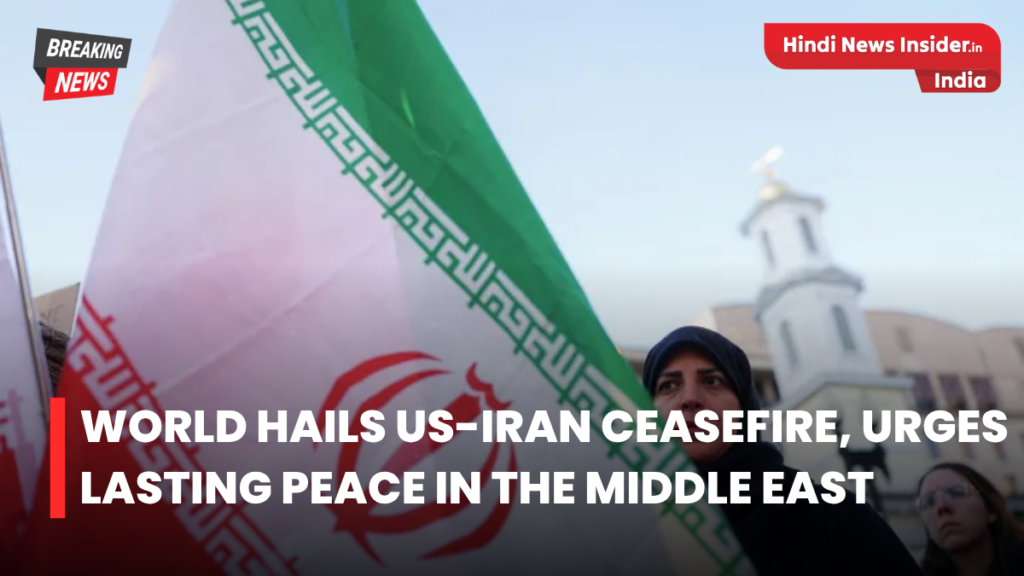
Lasting peace in the Middle East: The world watches with bated breath as a historic development unfolds in the tumultuous Middle East. Following intense diplomatic efforts, the United States and Iran have reached a pivotal two-week ceasefire agreement, a monumental step that global leaders hope will pave the way for lasting peace in the Middle East.
This truce, announced by US President Donald Trump, signals a significant de-escalation in tensions that have long gripped the region and threatened global stability. With talks to finalize a comprehensive peace deal slated to commence in Islamabad, Pakistan, on Friday, the international community is rallying behind this initiative, urging both parties to commit fully to the terms and seize this unprecedented opportunity for a durable resolution.
Join our social media platform
Central to this agreement is Iran’s commitment to reopen the Strait of Hormuz, a critical maritime artery through which approximately one-fifth of the world’s oil supply navigates. Its closure, or even the threat of it, has historically sent ripples through global energy markets and underscored the profound economic implications of regional instability.
The reopening not only offers immediate relief to international trade but also symbolizes a crucial return to norms that are essential for fostering lasting peace in the Middle East. The collective sigh of relief from nations worldwide is palpable, as governments and international bodies alike express their strong support for this ceasefire and the promising diplomatic path it illuminates.
The Genesis of a Fragile Truce: A Pathway to Lasting Peace in the Middle East
For years, the relationship between the United States and Iran has been characterized by escalating rhetoric, regional proxy conflicts, and a pervasive sense of mistrust. From the intricacies of Iran’s nuclear program to its significant influence across various Middle Eastern states, the points of contention have been numerous and deeply entrenched.
The recent period has seen a particularly alarming surge in hostilities, including attacks on commercial vessels, alleged cyber warfare, and direct confrontations between US forces and Iran-aligned groups in Iraq and Syria. This dangerous cycle of violence pushed the region to the brink, making the need for a diplomatic off-ramp more urgent than ever.
The announcement of a two-week ceasefire, therefore, is not merely a temporary halt in fighting but a testament to the persistent efforts of international diplomacy. US President Donald Trump’s declaration on Tuesday set the stage for a period of calm, allowing space for the complex negotiations required to forge lasting peace in the Middle East.
The decision to host these crucial talks in Islamabad, Pakistan, underscores the collaborative spirit and the essential role of neutral facilitators in navigating such high-stakes diplomacy. The world now awaits the outcome, understanding that the path forward is fraught with challenges, yet filled with the potential for a transformative breakthrough.
The agreement’s immediate impact, beyond the cessation of hostilities, is the reopening of the Strait of Hormuz. This strategic choke point, connecting the Persian Gulf to the open ocean, is indispensable for global energy security. Its accessibility is vital for the flow of oil and gas, influencing global prices and economic stability.
Iran’s commitment to restore unimpeded passage through the strait is a significant confidence-building measure, signaling a willingness to de-escalate and engage constructively. This action alone carries immense weight, demonstrating a tangible step towards economic normalization and setting a positive precedent for achieving lasting peace in the Middle East.
Read more: US Politicians React with Caution and Relief to Trump’s Iran Ceasefire
Global Acclaim: A Wave of Optimism for Lasting Peace in the Middle East
The announcement of the US-Iran ceasefire has been met with widespread international approval, highlighting the universal desire for stability and lasting peace in the Middle East. Leaders and diplomatic bodies across continents have lauded the development, recognizing its potential to reshape regional dynamics and alleviate human suffering.
Israel’s Cautious Endorsement Amidst Ongoing Conflict
Israeli Prime Minister Benjamin Netanyahu, a staunch critic of Iran, expressed support for President Trump’s decision to suspend strikes. On X, Netanyahu affirmed his backing for “US effort to ensure that Iran no longer poses a nuclear, missile and terror threat to America, Israel, Iran’s Arab neighbours and the world.” This endorsement, while significant, was notably conditional.
Netanyahu explicitly stated that the ceasefire “does not include Lebanon,” where Israeli forces are engaged in a ground invasion against the Iran-aligned Hezbollah.
This caveat underscores the intricate and multi-faceted nature of regional conflicts, illustrating that achieving comprehensive lasting peace in the Middle East will require addressing numerous interconnected flashpoints beyond the immediate US-Iran dynamic. Israel’s security concerns, particularly regarding Hezbollah’s military capabilities and Iran’s regional proxies, remain a critical factor in the broader strategic landscape.
Iraq’s Plea for Lasting Commitment to Peace Efforts
Iraq, a nation often caught in the crossfire of US-Iran tensions, welcomed the ceasefire with a plea for genuine commitment from both parties. The Iraqi Ministry of Foreign Affairs emphasized the necessity for both the US and Iran to adhere strictly to the deal to achieve a “lasting resolution.” The ministry stressed its support for “regional and international efforts to contain crises and prioritise the language of dialogue and diplomacy,” while also urging “full commitment to the ceasefire and refraining from any escalations.”
Having been drawn into the US-Israeli war on Iran, with Tehran-backed armed groups and US forces frequently trading fire, Iraq understands firsthand the devastating consequences of unchecked hostilities. For Iraq, the ceasefire represents a vital opportunity to stabilize its own fragile security environment and contribute genuinely to lasting peace in the Middle East.
Egypt’s Diplomatic Push for De-escalation and Dialogue
The Egyptian Ministry of Foreign Affairs hailed the ceasefire as “a very important opportunity that must be seized to make room for negotiations, diplomacy, and constructive dialogue.” In a statement, Egypt underscored the importance of building upon the truce with “a full commitment to stopping military operations and respecting freedom of international navigation.” This highlights Egypt’s strategic interest in regional stability and the unimpeded flow of global commerce.
The ministry also affirmed Egypt’s continued collaborative efforts with Pakistan and Turkiye “to promote security and stability in the region,” and stressed that the upcoming talks between the US and Iran “must take into account the legitimate security concerns” of Gulf nations. This emphasizes the need for an inclusive approach that addresses the anxieties of all regional stakeholders to truly achieve lasting peace in the Middle East.
Read more: A Beacon of Hope: The US-Iran Ceasefire Deal and the Path to De-escalation in the Middle East
International Bodies and Key Allies React
Beyond the immediate region, international organizations and key global players have voiced their strong support, recognizing the far-reaching implications of the US-Iran truce.
United Nations: Championing Civilian Protection and Comprehensive Peace
UN Secretary-General Antonio Guterres welcomed the announcement, urging all parties to “abide by the terms of the ceasefire in order to pave the way toward a lasting and comprehensive peace in the region.” His spokesperson conveyed Guterres’s emphasis on the urgent need “to protect civilian lives and alleviate human suffering,” a poignant reminder of the human cost of conflict.
The Secretary-General also extended gratitude to Pakistan and other facilitating nations, acknowledging their crucial role in bringing the parties to the negotiating table. The UN’s consistent advocacy for dialogue and de-escalation underscores its commitment to fostering lasting peace in the Middle East and safeguarding human rights amidst geopolitical rivalries.
Asian Powers Welcome De-escalation
Several influential Asian nations have expressed their optimism regarding the ceasefire, recognizing its positive impact on global trade and regional stability.
Japan’s Hope for a Final Agreement
Japan’s Chief Cabinet Secretary Minoru Kihara characterized the ceasefire as a “positive move,” expressing Tokyo’s anticipation for a “final agreement.” As a major energy importer heavily reliant on stable maritime routes, Japan has a vested interest in the de-escalation of hostilities in the Middle East, which remains a top priority for its foreign policy. The prospect of a secure Strait of Hormuz and reduced regional tensions offers significant economic reassurance to Japan and other Asian economies, reinforcing the global desire for lasting peace in the Middle East.
Indonesia’s Call for Diplomacy and Accountability
Indonesia’s Foreign Ministry, through Yvonne Mewengkang, welcomed the ceasefire deal, urging Iran and the US to respect “sovereignty, territorial integrity and diplomacy” of each side. This call for adherence to international norms is crucial for building trust and ensuring the sustainability of any peace agreement.
Mewengkang also seized the opportunity to call for a thorough investigation into the deaths of three Indonesian UN peacekeepers killed in Lebanon in late March amid fighting between Israeli forces and Hezbollah. This highlights the broader humanitarian concerns that intertwine with regional conflicts and the need for accountability even as steps are taken towards lasting peace in the Middle East.
Malaysia’s Emphasis on Regional Stability and Global Security
Malaysia’s Ministry of Foreign Affairs described the ceasefire as a “significant development” and a “crucial step towards de-escalating tensions and restoring much-needed peace and stability” to the Middle East. It urged “all parties to fully respect and implement all terms of the ceasefire in good faith to prevent any return to hostilities,” while also cautioning against “provocative actions or unilateral measures that could negatively impact the fragile stability of the region or jeopardise global economic and energy security.”
Malaysia’s statement underscores the interconnectedness of regional stability with global economic well-being, reiterating the collective hope for lasting peace in the Middle East.
Western Allies Express Relief and Future Hopes
Key Western allies of the United States have also joined the chorus of international approval, emphasizing the broader economic and humanitarian benefits of de-escalation.
Australia’s Focus on Economic Stability and Lasting Resolution
Australian Prime Minister Anthony Albanese and Minister for Foreign Affairs Penny Wong issued a joint statement welcoming the news and expressing their hopes for a “long-lasting resolution.” They highlighted the severe economic repercussions of previous hostilities, noting that “Iran’s de facto closure of the Strait of Hormuz, coupled with its attacks on commercial vessels, civilian infrastructure, and oil and gas facilities, is causing unprecedented energy supply shocks and impacting oil and fuel prices.”
Their statement underscored the global economic imperative for lasting peace in the Middle East, asserting that “the longer the war goes on, the more significant the impact on the global economy will be, and the greater the human cost.” They also extended thanks to Pakistan, Egypt, Turkiye, and Saudi Arabia for their critical roles as negotiators.
New Zealand’s Pragmatic Optimism for a Durable Truce
New Zealand Minister of Foreign Affairs Winston Peters welcomed the ceasefire, though he tempered optimism with a dose of pragmatism, acknowledging that “many concerns remain.” He noted that “while this is encouraging news, there remains significant important work to be done in the coming days to secure a lasting ceasefire.”
Peters highlighted the “wide-ranging impacts and disruptions” the conflict has had on the Middle East and beyond, demonstrating a clear understanding of the complexity involved in achieving lasting peace in the Middle East. He also praised Pakistan, Turkiye, and Egypt for their tireless efforts in negotiating the deal.
The Road Ahead: Challenges and Opportunities for Enduring Peace
While the ceasefire represents a significant diplomatic triumph, the real work of forging lasting peace in the Middle East now begins. The upcoming talks in Islamabad will be a crucible for complex negotiations, where deeply entrenched grievances, strategic interests, and historical mistrust must be navigated with extreme care.
The Weight of Expectations in Islamabad
The two-week ceasefire provides a crucial window, but the peace deal itself will require addressing fundamental disagreements. The talks in Pakistan will likely delve into a myriad of issues, from the specifics of security guarantees to the mechanisms for verifying compliance.
The success of these negotiations will hinge on the willingness of both the US and Iran to make genuine concessions and to envision a future where their interests can coexist without constant friction. The international community’s role as a guarantor and facilitator will be indispensable in ensuring that these discussions remain constructive and focused on achieving lasting peace in the Middle East.
Addressing Core Issues: Nuclear Ambitions, Regional Influence, and Sanctions
For any peace deal to be truly durable, it must tackle the underlying issues that have fueled the US-Iran rivalry for decades. Iran’s nuclear program remains a primary concern for the US and its allies, necessitating robust verification mechanisms and assurances against proliferation.
Equally critical is the issue of Iran’s regional influence, particularly its support for various non-state actors and its ballistic missile program. Conversely, Iran will undoubtedly seek relief from crippling economic sanctions, which have severely impacted its economy and its populace. Finding a balanced resolution that addresses these complex, interconnected issues will be paramount to securing lasting peace in the Middle East.
The Role of Regional Stakeholders
The path to lasting peace in the Middle East cannot be charted in isolation. The security concerns and strategic interests of other regional powers—such as Saudi Arabia, the United Arab Emirates, Turkey, and others—must be considered. An inclusive framework that acknowledges these diverse perspectives and seeks their constructive engagement will be vital for building a stable and sustainable regional order. The efforts of Pakistan, Egypt, and Turkiye in facilitating the current truce suggest a growing recognition of the importance of broader regional ownership in peace processes.
Maintaining the Truce: A Fragile Balance
Even if a peace deal is reached, its implementation and maintenance will require constant vigilance. The Middle East is a region where trust is scarce and provocations can quickly derail progress. Both the US and Iran, along with the international community, will need to establish robust mechanisms for communication, de-escalation, and conflict resolution to prevent any return to hostilities.
The reopening of the Strait of Hormuz, while a positive step, also highlights the need for continued commitment to respecting freedom of international navigation and avoiding any actions that could jeopardize global economic and energy security.
Economic Implications of Open Waterways
The reopening of the Strait of Hormuz is not just a symbolic gesture; it has profound economic implications. A secure and open strait reassures global markets, stabilizes oil prices, and facilitates international trade. This economic dividend can serve as a powerful incentive for both the US and Iran to maintain the peace, demonstrating that cooperation yields tangible benefits far greater than the costs of conflict. Sustaining this economic stability will be a key component in reinforcing the drive for lasting peace in the Middle East.
Conclusion: A Moment of Hope for Lasting Peace in the Middle East
The two-week ceasefire between the United States and Iran marks a critical juncture in the quest for lasting peace in the Middle East. It is a testament to the power of diplomacy and the unwavering global desire for stability in a region long plagued by conflict. The overwhelming international welcome for this development, from the UN Secretary-General to leaders across Asia and the West, underscores the universal recognition of its significance.
While the immediate cessation of hostilities and the reopening of the Strait of Hormuz offer a much-needed respite and economic reassurance, the journey ahead remains arduous. The upcoming talks in Islamabad will demand courage, foresight, and a genuine commitment from both Washington and Tehran to overcome decades of animosity and address the core issues that fuel regional instability.
The world watches, hopeful that this historic breakthrough will not merely be a temporary pause, but the defining first step towards a truly lasting peace in the Middle East, benefiting not only the region’s people but the entire global community.