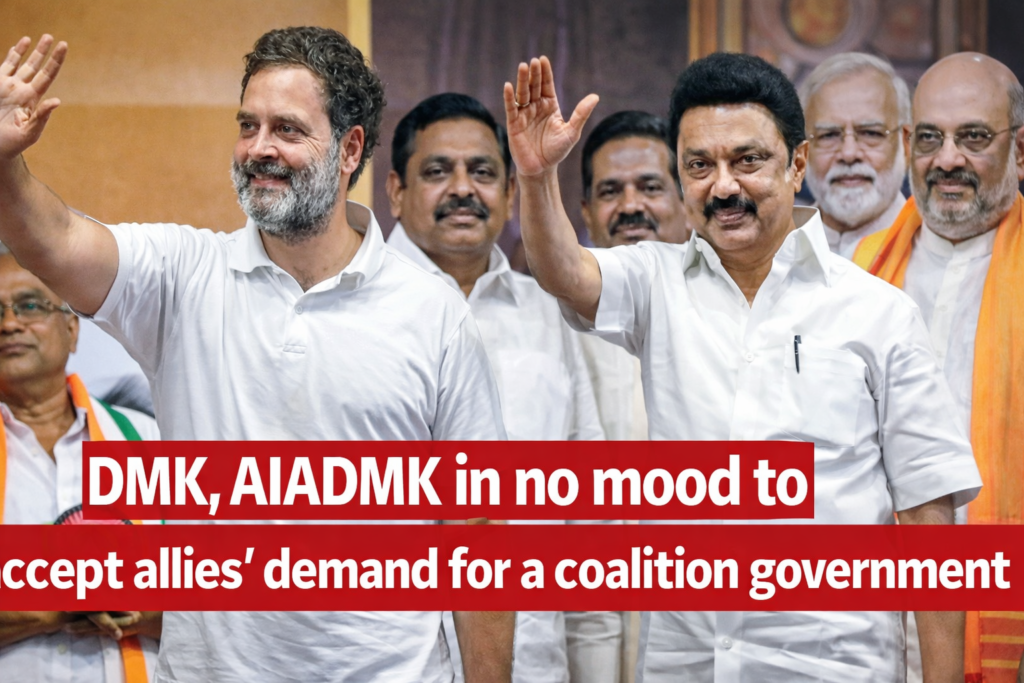
The time before the 2026 Tamil Nadu Assembly elections is unique because the main alliance partners, the Congress in the Dravida Munnetra Kazhagam (DMK)-led alliance and the BJP in the All India Anna Dravida Munnetra Kazhagam (AIADMK)-led alliance, both want cabinet positions after the elections. However, the DMK and AIADMK are in no mood to meet these demands.
Chief Minister M.K. Stalin said at a conclave hosted by a New Delhi television channel on February 11, “Power-sharing will not work in Tamil Nadu.” He added, “We know this. They [Congress] also know this.”
This is the first time the Chief Minister, who is also the party president, has directly addressed the Congress’s demand for a coalition government. He also insisted that despite recent controversies, there are no problems with the DMK-Congress alliance, and emphasized his personal relationship with Congress leader Rahul Gandhi.
Congress stands firm on its demand
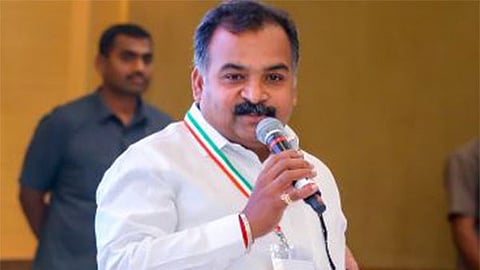
But those Congress members behind the idea of a coalition government have not backed down. After Stalin’s rejection of a coalition government, Congress MP Manickam Tagore said, “The people should decide – a coalition government or a single-party government.” He added, “It was the Congress party’s mistake not to implement the decision in 2006.” (In 2006, no party reached a simple majority of 117 seats; the DMK won 96 and the Congress 34.)
Tagore, who narrowly won Virudhunagar in 2024, is close to Congress General Secretary K.C. Venugopal, who makes many organizational decisions.
In the AIADMK camp, whenever Prime Minister Narendra Modi or Union Home Minister Amit Shah talk about a National Democratic Alliance (NDA)-led coalition in Tamil Nadu, AIADMK General Secretary Edappadi Palaniswami has been quick to speak out over the past few hours, insisting that the AIADMK will form a government on its own after the 2026 elections. Without directly mentioning Modi or Shah, Palaniswami has always made it clear that there is no question of a coalition government in the state.
Internal turmoil within the state BJP and problems within the Pattali Makkal Katchi (PMK) are helping the AIADMK, as both parties are trying to douse the fire within their own camps instead of demanding a coalition government.
Internal strife within the BJP
Factionalism within the BJP reached its peak this week. On February 9, the party’s National General Secretary (Organization), B.L. Santosh, called a meeting of state party leaders at the RSS office in Chennai to resolve all issues. Some state leaders are spreading media reports about other party members taking action against the party. This hastily called meeting appears to have blamed a key organizational figure for the current problems.
Given the BJP’s current situation, the party is unwilling to unite on any issue. State President, Nainar Nagendran, has clearly stated that he will not create problems for the AIADMK leadership in any way. His supporters claim that his focus is on securing as many seats as possible for the BJP and that he will not deviate from this goal in any way.
The closest the party came to forming a coalition government in Tamil Nadu was in 2006, when the DMK alliance won 163 seats, but the DMK could not secure a majority on its own. The DMK contested 96 of the 132 seats it contested, while the Congress won 34 of the 48 seats allotted to it. The PMK contested 18 of the 31 seats it contested.
Seat-sharing is difficult
This time, seat-sharing negotiations within the DMK alliance are difficult for two reasons. Given the experience of 2006, DMK leaders believe that the party will need to contest at least 170 seats to secure an absolute majority on its own.
Another reason is that the DMK is trying to include the late actor Vijayakanth’s party, the Desiya Murpokku Dravida Kazhagam (DMDK), in the alliance. The DMDK is demanding approximately 20 assembly seats along with one Rajya Sabha seat. According to reliable sources, the DMK is willing to give up six assembly seats and one Rajya Sabha seat. Given this new alliance, the DMK will have to request other allies to share the burden of seat-sharing with the DMDK.
Knowing this, almost all allies have told the DMK leadership that they want more seats for the 2026 elections. The Viduthalai Chiruthaigal Katchi (VCK), which has grown in size over the past decade, has rightly demanded an increase in its seats in the past few elections, but the DMK leadership has not yet acceded to this demand. The Congress is also demanding an increase in seats to strengthen its presence in the state. Allies demanding more seats will force the DMK to contest fewer seats than its previous target.
The DMK is aiming to extend seat-sharing talks until the end of February. For now, the party wants to focus on the interim budget, which will be presented on February 17. A party leader said: “The assembly session ends on February 22. A committee will be announced soon and negotiations will begin.”