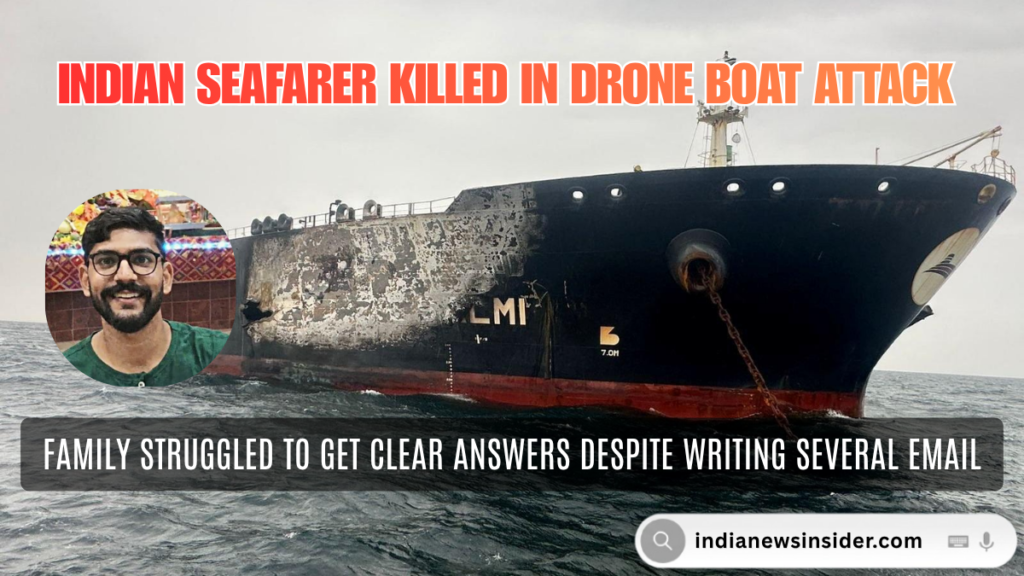
The somber journey of 25-year-old Dixit Solanki, an Indian seafarer tragically killed in a suspected drone boat attack off the Oman coast last month, has finally reached a poignant conclusion. His mortal remains arrived in Mumbai, a development that brings a measure of closure, albeit alongside profound grief, to his family after weeks of agonizing uncertainty.
The National Union of Seafarers of India (NUSI) confirmed the repatriation, highlighting the persistent challenges faced by maritime workers in an increasingly volatile geopolitical landscape. This incident underscores the severe human cost of regional conflicts in West Asia, placing the lives of innocent seafarers, including many from India, at grave risk.
Join our social media platform
The long and arduous process of Indian seafarer repatriation in such complex circumstances reveals significant bureaucratic hurdles and the emotional toll on families seeking answers and solace.
The Fatal Attack: A Glimpse into Maritime Peril
The incident that claimed Dixit Solanki’s life occurred on March 4, when an explosive-laden drone boat struck an oil tanker in the strategically crucial waters off the coast of Oman. While details surrounding the specific vessel and its operators remain TBD by the brief, the nature of the attack itself – a drone boat – points to a modern and sophisticated threat vector increasingly employed in regional conflicts.
Such attacks are designed to inflict maximum damage on commercial shipping, disrupt trade routes, and send geopolitical messages. For seafarers like Dixit, who are simply performing their duty, these waters have become a dangerous frontline.
The Gulf of Oman, situated near the Strait of Hormuz, is one of the world’s most vital maritime chokepoints, through which a significant portion of global oil and gas supplies pass. Consequently, it has become a flashpoint for various state and non-state actors operating within the broader West Asia conflict. The use of unmanned surface vessels (USVs) or “drone boats” laden with explosives represents an asymmetric threat that is difficult to detect and counter, posing an unprecedented danger to merchant ships.
For the Indian seafarer community, which forms a substantial part of the global maritime workforce, these incidents serve as stark reminders of the perils inherent in their profession. The death of a young individual like Dixit Solanki, a 25-year-old with his entire future ahead, tragically illustrates the severe and immediate consequences of these geopolitical tensions on innocent lives.
The attack not only resulted in the loss of life but also likely caused significant damage to the vessel, leading to further investigations and potential economic repercussions for the shipping industry.
The Family’s Agonizing Ordeal and Legal Battle for Repatriation
For Dixit’s father, Amratlal Solanki, and his sister, Mitali Solanki, the period following the attack was an agonizing test of endurance and resilience. Faced with the sudden and shocking news of their loved one’s death, they were then confronted with a frustrating lack of clarity and communication regarding the repatriation of his remains.
This bureaucratic stonewalling compounded their grief, transforming their sorrow into a determined fight for answers and the dignified return of Dixit. Their struggle highlights a common issue faced by families of victims in international incidents: navigating complex legal frameworks, multiple jurisdictions, and often slow-moving administrative processes.
Three days prior to the arrival of the remains in Mumbai, Amratlal and Mitali Solanki took a decisive step, approaching the Bombay High Court. Their petition sought explicit directions to the Union Government to expedite the repatriation process, citing the distressing “lack of clarity from the authorities.”
This legal intervention underscores the desperation felt by families when conventional channels fail to provide timely and adequate responses. The family’s plea to the court was not merely for the return of Dixit’s body; it was also a demand for transparency and accountability. They specifically sought that “all investigation and forensic records be shared with them,” an understandable request born out of the need to understand the precise circumstances of Dixit’s death and to ensure that justice, in whatever form, could be pursued.
The petition further claimed that the family had “struggled to get clear answers despite writing several emails to the company that owned the vessel,” indicating a breakdown in communication that added significantly to their distress. This legal battle for Indian seafarer repatriation became a public cry for assistance and a testament to their unwavering determination to honor Dixit’s memory.
NUSI’s Crucial Role in Support and Repatriation
The National Union of Seafarers of India (NUSI) played a pivotal role in facilitating the repatriation of Dixit Solanki’s remains and providing support to his grieving family. NUSI, as a prominent trade union representing the interests of Indian seafarers, often steps in during such crises, acting as an intermediary between families, shipping companies, government agencies, and international bodies.
Their involvement in this case underscores the vital function maritime unions perform in advocating for the rights and welfare of their members, especially in tragic circumstances.
Upon the arrival of the remains at the cargo terminal of Mumbai airport on Sunday, it was NUSI that confirmed Amratlal Solanki and Mitali Solanki’s presence to receive their loved one. This direct involvement signifies the union’s commitment to standing by its members and their families during their most difficult times. Beyond the logistical arrangements for Indian seafarer repatriation, NUSI’s role typically extends to providing legal assistance, counseling, and ensuring that families receive due compensation and benefits.
Their statement on the matter serves not only as an update on the case but also as a broader reminder of the risks faced by Indian seafarers globally and the need for robust support systems. The union’s consistent advocacy helps bring critical issues to the forefront, pushing for better safety standards, clearer communication protocols, and more efficient repatriation procedures in the event of tragedies.
The Broader Canvas: West Asia Conflict and Maritime Security
The death of Dixit Solanki is a stark reminder of the escalating geopolitical tensions in West Asia and their direct impact on global maritime trade and the lives of those who sustain it. The “West Asia war,” as broadly referenced, encompasses a range of conflicts and proxy battles, including the ongoing Red Sea crisis involving Houthi attacks on commercial shipping, and the long-standing “shadow war” between regional powers. These conflicts have transformed vital shipping lanes, particularly the Gulf of Oman and the Red Sea, into high-risk zones.
The region’s waterways are critical arteries for the global economy, facilitating the movement of vast quantities of oil, gas, and manufactured goods. The targeting of commercial vessels, whether by drones, missiles, or mines, not only endangers the lives of seafarers but also disrupts supply chains, increases insurance premiums, and raises the cost of international trade.
International maritime organizations, naval forces from various countries, and shipping companies are constantly grappling with how to ensure the safety of vessels and crew in this volatile environment. Measures like increased naval patrols, rerouting ships, and enhanced security protocols on board are being implemented, but no strategy can entirely eliminate the risks posed by determined adversaries using asymmetric warfare tactics.
The vulnerability of an Indian seafarer on an oil tanker to a drone boat attack illustrates the indiscriminate nature of these conflicts, where civilians become unwitting casualties in geopolitical struggles far beyond their control. This ongoing instability makes effective Indian seafarer repatriation even more challenging, as investigations can be complex and political sensitivities high.
Maritime Security Concerns: Protecting the Global Lifeline
The attack that killed Dixit Solanki underscores the evolving nature of threats to maritime security. Traditional piracy, while still a concern in certain areas, has been overshadowed by state-sponsored or proxy attacks utilizing advanced weaponry like drones and anti-ship missiles. This shift demands a re-evaluation of maritime security strategies and international cooperation.
The global shipping industry, responsible for transporting over 80% of world trade, relies on the free and safe passage of vessels. When this fundamental principle is challenged, the ripple effects are felt worldwide.
Numerous international initiatives, such as Operation Prosperity Guardian led by the United States, have been launched to protect shipping in the Red Sea and Gulf of Aden. However, the vastness of the oceans and the sheer volume of maritime traffic make comprehensive protection a monumental task. Shipping companies face immense pressure to balance economic viability with the safety of their crew and cargo.
This often involves making difficult decisions about route selection, enhancing vessel security, and ensuring adequate insurance coverage. For the substantial population of Indian seafarers working on international vessels, these security concerns are deeply personal. Their lives and livelihoods depend on the ability of governments and international bodies to maintain safe shipping lanes.
The incident highlights the urgent need for robust international frameworks for intelligence sharing, coordinated naval responses, and clear protocols for investigating and attributing such attacks to ensure accountability. Without such measures, the threat to seafarers and global trade will continue to escalate, making future instances of Indian seafarer repatriation under tragic circumstances an unfortunate inevitability.
The Human Cost of Geopolitical Tensions: Beyond the Headlines
While headlines often focus on geopolitical strategies, economic impacts, and military maneuvers, the story of Dixit Solanki brings into sharp focus the profound human cost of these tensions. Dixit was not a combatant; he was a young man working to support himself and likely his family, contributing to the global economy through his profession as an Indian seafarer. His death is not just a statistic but a deeply personal tragedy for his family and a loss for his community.
The emotional toll on families like the Solankis is immense. The uncertainty, the bureaucratic delays, and the sheer helplessness in the face of such a violent and distant death can leave indelible scars. Beyond Dixit, countless other seafarers navigate these dangerous waters daily, carrying with them the anxiety of potential attacks and the fear of not returning home.
This psychological burden is often overlooked but significantly impacts the mental health and well-being of the maritime workforce. The story of Dixit Solanki serves as a powerful reminder that behind every geopolitical conflict and every shipping route, there are human beings whose lives are directly affected.
It underscores the moral imperative for all parties involved in regional disputes to prioritize the safety of non-combatants and to adhere to international laws that protect civilian vessels and their crews. The painful process of Indian seafarer repatriation in this instance is a testament to the enduring grief and struggle for closure that families face.
Future Implications: Investigations, Compensation, and Lessons Learned
The repatriation of Dixit Solanki’s remains marks a significant milestone for his family, yet it is far from the end of their journey. The demands for “all investigation and forensic records” to be shared with them point towards a continuing quest for truth and, potentially, accountability.
The investigation into such an attack typically involves multiple stakeholders: the flag state of the vessel, the coastal state (Oman), the country of the victim (India), and potentially international maritime bodies. Determining the exact perpetrators and their motives is a complex process, often shrouded in geopolitical sensitivities.
Beyond the immediate investigation, there are crucial questions regarding compensation and support for Dixit’s family. Shipping companies typically have insurance policies that cover death in service, but navigating these claims can be arduous.
The role of the Indian government and organizations like NUSI will be critical in ensuring that the family receives all entitled benefits and support. Furthermore, this incident offers critical lessons for the maritime industry and governments worldwide. It highlights the need for:
- Enhanced Intelligence Sharing: Better real-time intelligence on potential threats in high-risk zones.
- Improved Communication Protocols: Clear and swift communication channels between shipping companies, governments, and families in times of crisis.
- Robust Repatriation Procedures: Streamlined and empathetic processes for the Indian seafarer repatriation of remains.
- Strengthened Maritime Security Measures: Continuous adaptation to evolving threats like drone attacks.
- International Diplomatic Efforts: Concerted efforts to de-escalate tensions in volatile regions to protect civilian lives and global trade.
The tragic death of Dixit Solanki should serve as a catalyst for renewed commitment from all stakeholders to protect the lives of those who tirelessly work to keep global trade flowing.
Conclusion
The arrival of Dixit Solanki’s mortal remains in Mumbai brings a heartbreaking end to his family’s agonizing wait, offering a semblance of closure amidst their profound sorrow. This incident is a grave reminder of the perilous conditions faced by Indian seafarers and their global counterparts in the increasingly militarized waters of West Asia.
His death underscores the tragic human cost of geopolitical tensions, where innocent lives are caught in the crossfire. The family’s courageous legal battle for transparency and expedited Indian seafarer repatriation highlights critical systemic issues that demand urgent attention from governments, shipping companies, and international bodies.
As the world grapples with escalating conflicts, the story of Dixit Solanki serves as a poignant call to action: to prioritize the safety and well-being of seafarers, to ensure robust support systems for their families, and to strive for a future where such tragic losses are prevented through de-escalation and international cooperation. The memory of Dixit Solanki must fuel a collective commitment to creating safer maritime environments for all.
Read More
- NDTV India is Hindi News Website. Read Hindi News, Latest Hindi News, Today Hindi News, Breaking Hindi News, Hindi Samachar
- Today’s news: Get latest and Breaking News on Politics, Business, Lifestyle, Entertainment and Sports along with News updates from around the world.
- Read the Latest News Updates online related to India, World and US business and economy.
- Times of India: News – Breaking News, Latest News, India.
- ભારતની તમામ નવી સરકારી યોજનાઓ 2026 વિશે માહિતી