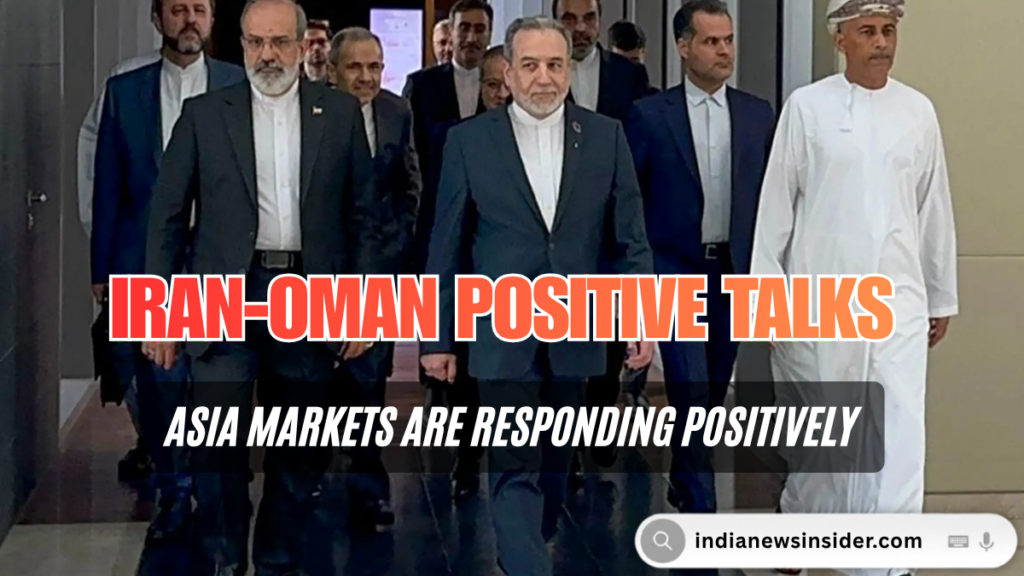
Iran-Oman Talks Boost Asian Markets: The global geopolitical landscape often presents a complex paradox, a delicate balance where escalating tensions can, surprisingly, be met with a sigh of relief in certain economic sectors. This intricate dynamic is currently playing out in Asia markets, which are positively responding to news of diplomatic overtures between Iran and Oman, even as broader regional anxieties persist.
Despite a backdrop of heightened threats from the U.S. and a significant surge in energy prices, this nascent dialogue has injected a much-needed dose of optimism, particularly for Asian economies heavily reliant on Middle Eastern energy supplies.
In the last 24 hours, the world witnessed an intensification of rhetoric, with the U.S. administration escalating its threats against Iran. Concurrently, energy markets have reflected this instability, with Brent crude trading around $110 a barrel, marking an 8 percent increase. Such developments would typically trigger widespread market panic, yet a remarkable reversal of yesterday’s sharp losses is observable across key Asian bourses.
This counter-intuitive reaction underscores a critical shift in investor focus: from the immediate crisis to the potential for stabilizing energy supply routes. The news of Iran-Oman talks, particularly reports of a “draft proposal” for transit through the strategically vital Strait of Hormuz, has emerged as the primary catalyst for this positive sentiment, offering a glimmer of hope that Iran-Oman talks boost Asian markets by mitigating critical supply chain risks.
Geopolitical Volatility and Energy Market Pressures
The current geopolitical climate in the Middle East remains fraught with peril, a condition exacerbated by recent pronouncements from the U.S. administration. These escalating threats against Iran have sent ripples of uncertainty across global capitals, raising concerns about potential military confrontations and their far-reaching economic consequences.
The memory of past regional conflicts and their immediate impact on global trade routes and energy supplies is still fresh in the minds of policymakers and investors alike. This inherent instability creates a volatile environment where any perceived escalation can swiftly translate into a risk premium on essential commodities.
The Escalating Rhetoric and Its Immediate Fallout
The rhetoric emanating from the U.S. administration has been unequivocal, signaling a hardened stance against Iran. Such declarations, often delivered with a tone of ultimatum, invariably heighten the perceived risk of military engagement. For international markets, this translates into a scramble to hedge against potential disruptions, particularly in crucial energy-producing regions.
The immediate fallout is a surge in oil prices, reflecting the market’s anticipation of supply constraints or outright blockades. This cycle of threats and price hikes creates a feedback loop, where geopolitical tension directly fuels economic anxiety.
The very act of a major power issuing such threats is enough to trigger defensive maneuvers from investors, leading to capital flight from riskier assets and a move towards safe havens. This is the prevailing environment in which the unexpected positive market reaction is occurring, making the impact of the Iran-Oman talks even more significant as they aim to counteract this prevailing negativity.
Brent Crude’s Ascent and the Global Energy Landscape
The recent surge in Brent crude prices to around $110 a barrel, an 8 percent increase, is a direct manifestation of these geopolitical anxieties. Brent crude, a global benchmark for oil prices, is highly sensitive to supply and demand dynamics, but equally, if not more so, to geopolitical risk. When the security of major oil-producing regions or transit routes is called into question, the price of crude oil almost invariably climbs.
This ascent reflects not necessarily a real-time shortage, but rather the market’s expectation of future supply disruptions. For energy-importing nations, particularly those with rapidly growing economies, such price hikes represent a significant economic burden. They can fuel inflation, increase production costs, and ultimately dampen consumer spending, posing a substantial threat to macroeconomic stability.
The global energy landscape, therefore, remains precariously balanced, with every diplomatic overture or military threat capable of tipping the scales. It is within this context that the news that Iran-Oman talks boost Asian markets is so impactful, as it directly addresses the critical issue of energy supply stability.
Read also: India Mariners Strait of Hormuz: Mariners Lost Amid Strait of Hormuz Blockade and Iran-US War
Iran-Oman Talks Boost Asian Markets: A Beacon of Stability
Amidst the swirling currents of geopolitical uncertainty and rising energy costs, the news of diplomatic discussions between Iran and Oman has emerged as a powerful counter-narrative, acting as a beacon of potential stability. These talks, focusing on critical transit routes, have provided a much-needed psychological boost to investors, signaling a possible de-escalation of risks to energy supplies.
The very fact that dialogue is occurring, particularly involving a nation often at the center of regional tensions, is seen as a positive development, suggesting that diplomatic solutions might still be accessible. Indeed, the perception that Iran-Oman talks boost Asian markets is rooted in the practical implications of securing vital energy lifelines.
The Diplomatic Breakthrough: A “Draft Proposal” for Hormuz
The most significant element of the Iran-Oman talks centers around reports of a “draft proposal” concerning transit through the Strait of Hormuz. This narrow waterway, connecting the Persian Gulf with the Arabian Sea, is arguably the world’s most critical oil chokepoint, through which a substantial portion of the world’s seaborne oil passes daily.
Any threat to its free passage sends immediate shockwaves through global energy markets. A “draft proposal” for transit, therefore, represents a monumental step towards de-risking this vital artery. While the specifics of the proposal remain undisclosed, its mere existence suggests a framework for ensuring uninterrupted passage, potentially involving guarantees, monitoring mechanisms, or agreed-upon protocols that could alleviate fears of blockades or disruptions.
This diplomatic breakthrough offers a tangible, albeit preliminary, mechanism to address the most pressing concern for energy-importing nations: the security of supply. The hope is that such a proposal could transform a flashpoint into a zone of predictable passage, which is precisely why Iran-Oman talks boost Asian markets so significantly.
Oman’s Pivotal Role in Regional Diplomacy
Oman has historically played a distinctive and often understated role as a mediator in the complex geopolitical landscape of the Middle East. With its balanced foreign policy and strong relationships with both Western powers and Iran, Oman possesses a unique diplomatic capital that few other nations in the region can claim.
Its quiet diplomacy often involves facilitating back-channel communications and fostering environments conducive to dialogue, even when overt communication channels are strained. In the current context, Oman’s involvement as a facilitator in talks between Iran and others is crucial. Its reputation as a neutral and trusted interlocutor lends credibility to the discussions and increases the likelihood of a constructive outcome.
This pivotal role underscores why any initiative spearheaded or supported by Oman is often viewed with greater optimism by the international community, especially when it concerns sensitive issues like regional security and energy transit. The nation’s consistent efforts to promote stability are a key reason why news of these particular talks has resonated so positively.
Asian Economies: Vulnerability and Resilience
Asian economies, particularly the industrial powerhouses of Northeast Asia, stand at a unique intersection of vulnerability and resilience when it comes to global energy dynamics. Their rapid growth and industrialization have been fueled by a steady and affordable supply of energy, much of which originates from the Middle East.
This dependence makes them uniquely susceptible to any disruptions in that region, yet their robust economic structures and diversified trade networks also afford them a degree of resilience. The unfolding situation with Iran and the Strait of Hormuz is a stark reminder of this delicate balance, and how the news that Iran-Oman talks boost Asian markets is directly tied to their economic well-being.
Why Asia Depends on the Middle East for Energy
The reliance of Asian economies on Middle Eastern energy imports is profound and multifaceted. Countries like Japan, South Korea, China, and India are among the world’s largest oil importers, with a significant majority of their crude oil and natural gas supplies traversing the Strait of Hormuz. This dependence is a legacy of their industrial development strategies and limited domestic energy resources. For these nations, energy security is not merely an economic concern but a fundamental aspect of national security.
Any threat to the free flow of oil from the Middle East directly imperils their manufacturing sectors, transportation networks, and overall economic stability. Diversification efforts have been ongoing, but the sheer volume and cost-effectiveness of Middle Eastern supplies mean that this reliance is unlikely to diminish significantly in the short to medium term. Consequently, any news that suggests a stabilization of these supply lines is met with considerable relief and positive market reaction.
Market Reactions: KOSPI, Nikkei 225, and Beyond
The immediate positive market reactions across Asia underscore this critical dependence. South Korea’s KOSPI index, a bellwether for the country’s export-oriented economy, surged by approximately 3 percent. Similarly, Japan’s Nikkei 225, representing another major industrial and technological hub, climbed by around 1 percent. While some regional markets, including Singapore, were closed for the long Easter weekend, the sentiment in open markets was unequivocally positive. These upticks are not merely speculative; they reflect a tangible easing of investor anxiety regarding the continuity of energy supplies.
For economies heavily vested in manufacturing and technology, predictable energy costs are paramount. The prospect of a “draft proposal” for Hormuz transit directly addresses this fundamental concern, allowing investors to re-evaluate risk premiums and channel capital back into growth-oriented assets. This robust response highlights the direct correlation between regional geopolitical stability and the health of Asian financial markets, reinforcing the idea that Iran-Oman talks boost Asian markets by reducing perceived economic threats.
Understanding the Market’s Logic: Supply Security Over Price Volatility
The market’s seemingly paradoxical reaction – an uptick in Asian indices despite rising Brent crude prices and escalating geopolitical threats – reveals a sophisticated understanding of underlying economic drivers. It’s not simply about the current price of oil, but rather the perceived security of its future supply. Investors are demonstrating that the certainty of energy flow, even if at a higher cost, is preferable to the ambiguity and potential disruption posed by an unstable Strait of Hormuz. This distinction is crucial for understanding why the news that Iran-Oman talks boost Asian markets has had such a profound impact.
The Psychology of Investor Confidence
Investor confidence is a delicate construct, heavily influenced by clarity and predictability. In times of geopolitical turmoil, uncertainty becomes the most significant deterrent to investment. The fear of an abrupt halt to oil supplies, or a severe escalation that disrupts trade routes, can lead to widespread divestment and market downturns. The news of Iran-Oman talks, however, introduces an element of predictability to a highly unpredictable situation.
It suggests that diplomatic channels are active and that efforts are being made to safeguard the flow of vital resources. This perception of proactive problem-solving, even at an early stage, is enough to lift investor spirits. It signals that while challenges remain, there are mechanisms in place to address them, thereby reducing the extreme tail-risk scenarios that often trigger market panics. This psychological shift from fear to cautious optimism is a powerful driver of market recoveries.
Differentiating Short-Term Price Spikes from Long-Term Supply Concerns
It is important to differentiate between short-term price spikes in commodities and long-term concerns about supply continuity. The recent 8 percent jump in Brent crude prices is largely a response to immediate geopolitical threats and speculative trading, reflecting a short-term risk premium. However, the positive reaction in Asian markets is addressing a more fundamental and long-term concern: the physical availability of energy. For industrial economies, the ability to access oil and gas is paramount, even if the price is higher than ideal.
A stable, albeit more expensive, supply is infinitely preferable to an interrupted or blocked supply, which could cripple entire industries. The Iran-Oman talks are effectively addressing this long-term supply security issue, alleviating fears of sustained disruptions rather than merely fluctuating prices. This strategic focus on ensuring the flow of energy, as opposed to just its cost, explains why the market is willing to look past the immediate price increase and celebrate the prospect of stabilized transit.
The Strategic Importance of the Strait of Hormuz
The Strait of Hormuz is more than just a waterway; it is a geopolitical fault line and an economic linchpin. Its strategic importance cannot be overstated, acting as a critical chokepoint for global energy markets and a focal point for regional power dynamics. Understanding its significance is key to grasping why any diplomatic effort concerning its transit, such as the Iran-Oman talks, elicits such a strong market reaction, affirming that Iran-Oman talks boost Asian markets by directly addressing this critical vulnerability.
A Global Chokepoint: Its Economic and Geopolitical Significance
As the only sea passage from the Persian Gulf to the open ocean, the Strait of Hormuz is the world’s most important oil transit chokepoint. Approximately one-fifth of the world’s total petroleum liquids consumption, and a substantial portion of the world’s liquefied natural gas (LNG), passes through this narrow 21-mile-wide channel annually. The countries bordering the Persian Gulf, including Saudi Arabia, Iran, the UAE, Kuwait, and Iraq, rely heavily on the Strait for their oil and gas exports.
Any disruption, whether due to military conflict, political blockade, or even severe weather, would have catastrophic consequences for global energy supplies and prices. Economically, such a disruption would trigger a worldwide recession, causing energy shortages, inflationary spirals, and significant trade imbalances. Geopolitically, control or influence over the Strait is a source of immense power and leverage, making it a constant point of tension and strategic maneuvering among regional and global powers.
Mitigating Risk Through Diplomatic Channels
Given the immense stakes, diplomatic efforts to secure the Strait of Hormuz are critically important. The “draft proposal” emerging from the Iran-Oman talks represents a significant step towards mitigating the inherent risks associated with this chokepoint. By establishing agreed-upon protocols or guarantees for transit, such a proposal aims to depoliticize the Strait and ensure its functionality as a neutral international waterway.
This kind of diplomatic engagement seeks to build confidence and reduce the likelihood of unilateral actions that could trigger a crisis. It acknowledges that while military options exist, a negotiated and mutually acceptable framework for transit is the most sustainable path to regional stability and global energy security. The very existence of such discussions signals a commitment to finding peaceful resolutions to complex geopolitical challenges, thereby significantly reducing the risk premium associated with the region.
The Path Ahead: Cautious Optimism and Lingering Uncertainties
While the news of the Iran-Oman talks has undoubtedly lifted investor spirits and provided a much-needed respite for Asian markets, the path ahead remains characterized by cautious optimism and lingering uncertainties. A “draft proposal” is a promising start, but it is far from a finalized agreement or a guaranteed resolution. The complexities of regional politics, coupled with the unpredictable nature of international relations, mean that challenges persist. The sentiment that Iran-Oman talks boost Asian markets is strong, but it is also tempered by a realistic assessment of the hurdles that lie ahead.
From Draft to Resolution: The Implementation Challenge
Moving from a “draft proposal” to a fully implemented and ratified resolution is often the most challenging phase of any diplomatic endeavor. A draft signifies an initial agreement on principles and potential mechanisms, but the devil is always in the details. Negotiations will likely involve intricate discussions on specific transit rules, monitoring protocols, enforcement mechanisms, and guarantees to all parties involved.
Furthermore, any agreement involving the Strait of Hormuz would likely require broader international recognition and support to be truly effective and enduring. The process of translating a conceptual framework into actionable policy can be lengthy and fraught with potential setbacks. Success will depend not only on the goodwill of the immediate parties but also on their ability to navigate external pressures and internal political considerations, ensuring that the initial positive momentum translates into a tangible and lasting solution.
The Shadow of Geopolitical Unpredictability
Despite the positive developments in the Iran-Oman talks, the broader shadow of geopolitical unpredictability continues to loom large. The U.S. administration’s escalating threats against Iran remain a significant source of tension, and their potential impact on the region cannot be discounted. Any sudden shift in diplomatic stance, a miscalculation, or an unforeseen incident could quickly unravel the progress made in bilateral talks.
Moreover, the Middle East is a region with multiple actors and complex interdependencies, meaning that events unrelated to the Iran-Oman dialogue could still trigger wider instability. Investors are acutely aware of this inherent volatility, and while they are celebrating the current diplomatic breakthrough, they remain vigilant for any signs of renewed escalation. This dual perspective – embracing positive news while acknowledging persistent risks – defines the current market sentiment.
Broader Economic Implications for the Region
The implications of stable energy supplies, as potentially secured by the Iran-Oman talks, extend far beyond just commodity prices and stock market indices. For Asian economies, the assurance of uninterrupted energy flow has profound broader economic implications, touching upon trade, inflation, investment, and even regional stability. The understanding that Iran-Oman talks boost Asian markets is really a recognition of their potential to foster a more predictable and prosperous economic environment.
Impact on Trade, Inflation, and Investment
Stable energy supplies are foundational for robust trade and economic growth in Asia. Predictable energy costs allow manufacturers to plan production cycles more effectively, reduce input costs, and maintain competitive pricing for their exports. Conversely, energy supply disruptions or extreme price volatility can lead to increased production costs, which are often passed on to consumers as inflation, eroding purchasing power and potentially slowing economic growth. For countries heavily reliant on manufacturing and exports, such as South Korea and Japan, the ability to import energy reliably is directly linked to their trade balances and overall economic health.
Furthermore, a stable energy outlook encourages long-term investment, both domestic and foreign, as businesses are more willing to commit capital in an environment where fundamental operational costs are predictable. The Iran-Oman talks, by addressing this core requirement, could therefore stimulate greater investment and foster healthier trade relationships across the region.
A Catalyst for Regional Stability?
Beyond the immediate economic benefits, the success of the Iran-Oman talks could serve as a powerful catalyst for broader regional stability. Diplomatic engagement on critical issues, particularly those concerning shared resources and transit routes, builds trust and fosters channels for communication that can be leveraged for other regional challenges. A successful resolution to the Strait of Hormuz transit issue could demonstrate the efficacy of diplomacy over confrontation, potentially encouraging further dialogue on other contentious matters.
For Asian nations, a more stable Middle East translates into reduced geopolitical risk premiums, lower insurance costs for shipping, and greater confidence in long-term supply chains. While one set of talks cannot single-handedly resolve all regional conflicts, it can certainly set a positive precedent and contribute significantly to a more peaceful and predictable operating environment, ultimately benefiting global trade and prosperity.
Conclusion
The recent positive response in Asian markets to news of Iran-Oman talks stands as a compelling testament to the power of diplomacy, even amidst a turbulent geopolitical landscape. Despite escalating tensions and rising energy prices, the prospect of a “draft proposal” for transit through the Strait of Hormuz has provided a much-needed psychological and practical anchor for investors. This reaction underscores a critical insight: for energy-dependent Asian economies, the certainty of supply, even at a higher cost, often outweighs the immediate concerns of price volatility.
The significant upticks in indices like South Korea’s KOSPI and Japan’s Nikkei 225 are not mere speculative bounces but reflect a genuine alleviation of fears concerning the physical flow of essential energy resources. Oman’s pivotal role as a mediator has been instrumental in fostering this dialogue, offering a beacon of stability in an otherwise unpredictable region. While the journey from a “draft proposal” to a fully implemented resolution will undoubtedly face challenges, the initial positive momentum signals a crucial shift in focus from crisis management to proactive risk mitigation.
The understanding that Iran-Oman talks boost Asian markets highlights the profound interconnectedness of global geopolitics and economic stability. As these discussions unfold, the world will be watching closely, hopeful that this diplomatic overture will pave the way for greater predictability, enhanced energy security, and ultimately, a more stable and prosperous future for both the Middle East and the vital Asian economies it serves.
Read More
- NDTV India is Hindi News Website. Read Hindi News, Latest Hindi News, Today Hindi News, Breaking Hindi News, Hindi Samachar
- Today’s news: Get latest and Breaking News on Politics, Business, Lifestyle, Entertainment and Sports along with News updates from around the world.
- Read the Latest News Updates online related to India, World and US business and economy.
- Times of India: News – Breaking News, Latest News, India.
- ભારતની તમામ નવી સરકારી યોજનાઓ 2026 વિશે માહિતી