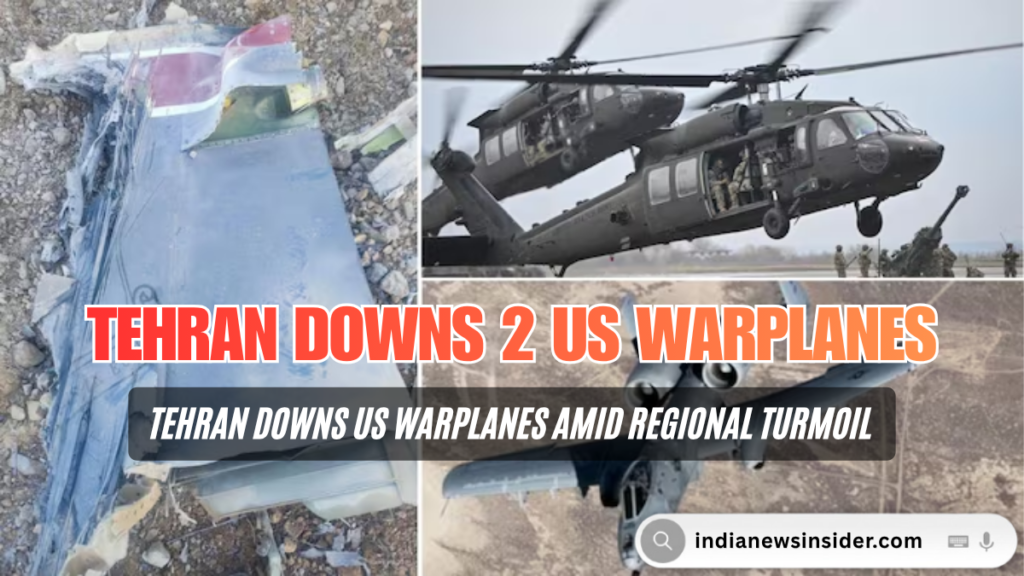
The Middle East finds itself at a perilous precipice, teetering on the brink of an unprecedented conflict as a dangerous Iran-US Conflict Escalation unfolds. In a dramatic turn of events, Iran has boldly claimed to have shot down two US warplanes, an assertion that has sent shockwaves across the globe and ignited fervent celebrations within the Islamic Republic.
This critical development comes hand-in-hand with reports of Israeli airstrikes targeting bridges in Lebanon, painting a grim picture of rapidly intensifying regional hostilities. The current situation demands urgent attention, as the implications of these actions could reshape the geopolitical landscape for years to come.
Join our social media platform
Iran’s Defiant Stance and Claimed Military Prowess
The initial report from Tehran detailed the downing of the first US aircraft in the early hours of Friday. The incident occurred in southwestern Iran, prompting local authorities to seek civilian assistance in the urgent search for the pilot. This event, shrouded in the fog of war, immediately signaled a significant escalation in the ongoing tensions between Iran and the United States.
Shortly thereafter, a second claim emerged: another US aircraft, identified as an A-10 Warthog, had been shot down in the strategically vital Gulf region, near the Strait of Hormuz. The Iranian military proudly declared responsibility, initiating a search for the pilots of this second downed plane. The A-10 Warthog, renowned for its close air support capabilities, represents a substantial asset, and its alleged downing underscores a potentially serious challenge to US air superiority in the region.
These statements, delivered with an undeniable sense of triumph, have been met with widespread jubilation across Iran. Streets that have witnessed nightly celebrations since the conflict began now pulsate with a renewed vigor. The Iranian populace and government alike view these events as a powerful vindication of their long-standing promises.
From day one of the conflict, Iran has vowed to unleash “new surprises” and leverage “undeployed capabilities.” Today, they assert, those capabilities have been unequivocally demonstrated, offering a stark warning to their adversaries. This defiant mood, fueled by a narrative of victory and resilience, is a critical component of the current Iran-US Conflict Escalation.
Read also: Iran-Oman Talks Boost Asian Markets Amidst Geopolitical Tensions
Strategic Ramifications and Underestimated Capabilities
The message emanating from Tehran is one of unyielding defiance and self-proclaimed victory. Iranian officials are promising further attacks, vehemently asserting that the Americans have gravely underestimated the sophisticated capabilities of the Iranian army and the Islamic Revolutionary Guard Corps (IRGC). This narrative aims to bolster domestic morale and project an image of formidable military strength to the international community.
While details surrounding the shoot-downs remain scarce, Iranian authorities confirm the targeting of “several helicopters and drones,” with some drones reportedly brought down. This broader targeting strategy suggests a multi-layered air defense capability, potentially involving a combination of advanced surface-to-air missile systems and electronic warfare. The successful engagement of not just warplanes but also unmanned aerial vehicles and rotary-wing assets indicates a comprehensive approach to challenging adversary airpower.
The alleged downing of two US warplanes represents a significant blow, both symbolically and potentially operationally. For Iran, it is a powerful demonstration of its capacity to continue the fight and, crucially, to inflict tangible losses on a technologically superior opponent. The underlying message is clear: Iran believes it possesses the means to “have the last laugh” in this high-stakes showdown with the Americans. This perceived success is injecting new morale into the Iranian armed forces and strengthening public support for the government’s stance, further fueling the dynamics of Iran-US Conflict Escalation.
The Broader Regional Unrest: Israel’s Strikes on Lebanon
Adding another layer of complexity and danger to the already volatile situation are reports of Israeli airstrikes targeting bridges in Lebanon. While the direct link between these strikes and the alleged downing of US planes remains unclear, they are undeniably part of the same escalating regional conflict. Israel’s actions in Lebanon typically target infrastructure or assets linked to Hezbollah, a powerful Iranian-backed militant group. Such strikes are often retaliatory or pre-emptive, aimed at degrading Hezbollah’s capabilities or preventing perceived threats.
The targeting of bridges, vital for transportation and logistics, signifies a deliberate attempt to disrupt movement and potentially isolate areas. This particular action carries significant humanitarian and economic implications for Lebanon, a nation already grappling with profound internal crises. It also raises the specter of a wider front opening up, drawing Lebanon more deeply into the regional conflagration. The interplay between Iran’s actions, US responses, and Israel’s continued operations creates a dangerous feedback loop, where each move risks triggering a disproportionate counter-response, accelerating the Iran-US Conflict Escalation across multiple fronts.
International Repercussions and Calls for De-escalation
The unfolding events have triggered alarm bells across international diplomatic circles. The alleged downing of US warplanes by Iran, if confirmed by independent sources, marks a severe escalation that could necessitate a robust response from Washington. Such an incident directly challenges US military presence and prestige in the Middle East, potentially compelling a retaliatory action that could spiral into a full-scale war.
World powers, including the United Nations, European Union, China, and Russia, are likely to call for immediate de-escalation and restraint from all parties. The Strait of Hormuz, a critical chokepoint for global oil supplies, becomes even more precarious with these developments. Any significant disruption in the Strait could send oil prices skyrocketing, triggering a global economic crisis. The international community fears that the current trajectory could lead to an uncontrollable regional conflict with devastating global consequences, making the need to manage the Iran-US Conflict Escalation paramount.
Historical Context and the Path Forward
The current Iran-US Conflict Escalation is not an isolated incident but rather the culmination of decades of animosity, proxy wars, and diplomatic stalemates between Tehran and Washington. From the 1979 Iranian Revolution to the nuclear deal and its subsequent unraveling, the relationship has been fraught with tension. Each incident, whether it be sanctions, naval encounters, or aerial confrontations, has contributed to the deep-seated mistrust and readiness for confrontation that characterizes the present moment.
As search operations for the pilots continue and the world holds its breath, the path forward remains fraught with uncertainty. The immediate priority for all stakeholders must be to prevent further loss of life and to establish channels for de-escalation. However, with Iran’s emboldened stance, the US’s need to project strength, and Israel’s ongoing security concerns, the prospects for a swift resolution appear dim. The Middle East stands at a critical juncture, where miscalculation or overreaction could ignite a devastating regional war, with far-reaching and unpredictable consequences for global stability.
Rescue Operation for Downed US Pilot Deemed “Highly Dangerous”
A potential US military operation to rescue a pilot from a downed F-15E fighter jet would be “highly dangerous,” according to Harlan Ullman, a former senior US naval officer and senior adviser at the Atlantic Council. Speaking to Al Jazeera, Ullman provided insights into the complexities and risks involved in such a mission, emphasizing the urgency and the formidable challenges facing US forces.
The Perilous Rescue Mission
Ullman’s assessment underscores the significant threats inherent in attempting to retrieve a downed airman in a hostile environment, highlighting both the tactical difficulties and the critical factors determining success.
A “Highly Dangerous” Undertaking
The former naval officer minced no words, stating unequivocally that any US operation to rescue the pilot would be “highly dangerous.” This assessment is based on the inherent risks of inserting forces into potentially contested territory, especially given the nature of the likely adversaries and the terrain.
Tactical Approach and Vulnerabilities
Detailing the probable methods, Ullman suggested the US military would likely launch “infantry operations, which are using helicopters, AC-130 gunships.” He specifically pointed out a critical vulnerability: these aircraft “are gonna be pulling at low altitude, and they are very vulnerable” to enemy fire. Despite the risks, he affirmed the elite capabilities of US forces, noting, “Our teams are the best in the business, and they will do their utmost to retrieve the second crewmember.”
The Airman’s Condition and Urgency
Ullman raised several pressing questions regarding the downed airman’s status, which would directly impact the rescue effort. “The question is, what condition is that member in? Has he been hurt by parachute drop? Does he have enough stuff to sustain himself? And are we gonna be able to get in there quickly enough to retrieve them?” These unknowns add layers of complexity and urgency to an already high-stakes situation.
Executing the Operation
The strategy for such a rescue operation would prioritize speed and efficiency, aiming to minimize exposure to hostile forces.
Swift In-and-Out Strategy
Contrary to conventional thinking, Ullman stated that the operation was “not likely to involve troops on the ground” in a sustained manner. Instead, the focus would be on a rapid “in and out as quickly as possible” approach, designed to extract the pilot without engaging in prolonged ground combat.
Locating, Isolating, Retrieving
The success of the mission hinges on a precise sequence of actions. Ullman outlined these steps: “What needs to be done is to locate the position of the downed airman, and then be able to isolate the terrain, so that we keep off any enemy soldiers from nearby, and then to get in quickly, scooping them up probably by helicopter.” This coordinated effort aims to secure the immediate area long enough for extraction.
The Iranian Factor
The geopolitical context, particularly the involvement of Iran, adds a critical dimension of urgency and danger to the rescue attempt.
Race Against Time
The operation needs to be carried out “as soon as possible” due to the significant efforts by Iranian forces. Ullman noted that the Iranians have launched an extensive manhunt, creating a race against time for US rescue teams.
The Value of a Live Capture
A key motivator for the swift execution of the rescue is the underlying interest of the Iranian forces. Ullman explained that “it is in their interest to capture an American alive,” implying the potential for propaganda or intelligence value. This drastically increases the stakes and the urgency for the US to retrieve its pilot before capture.
Read More
- NDTV India is Hindi News Website. Read Hindi News, Latest Hindi News, Today Hindi News, Breaking Hindi News, Hindi Samachar
- Today’s news: Get latest and Breaking News on Politics, Business, Lifestyle, Entertainment and Sports along with News updates from around the world.
- Read the Latest News Updates online related to India, World and US business and economy.
- Times of India: News – Breaking News, Latest News, India.
- ભારતની તમામ નવી સરકારી યોજનાઓ 2026 વિશે માહિતી