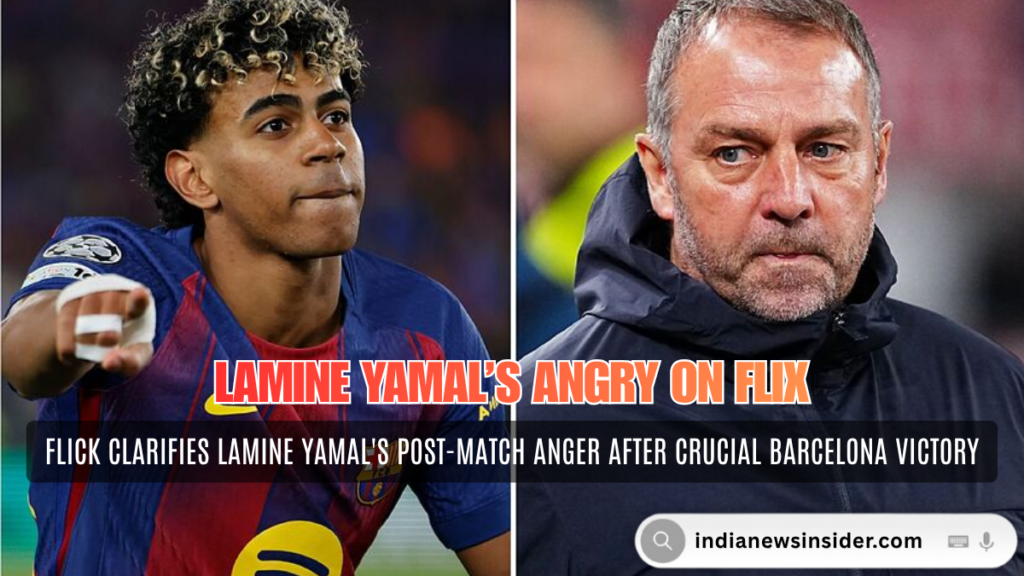
Lamine Yamal’s Post-Match Anger: The recent La Liga clash between Barcelona and Atletico Madrid, which saw the Catalan giants secure a vital victory, was overshadowed by an unusual scene involving one of their brightest young stars. Lamine Yamal’s Post-Match Anger became a significant talking point, as the prodigious forward was visibly unhappy despite his team’s hard-fought win.
However, Barcelona’s astute manager, Hansi Flick, was quick to downplay the incident, offering a clear and reassuring explanation that attributed the young Spaniard’s frustration solely to his on-field performance and missed opportunities, rather than any external or off-field issues.
Join our social media platform
Flick’s calm assessment aimed to dispel any lingering speculation, asserting that Yamal’s emotional reaction stemmed from the natural desire of a competitive athlete to contribute more decisively, particularly in front of goal. This incident, while brief, offered a rare glimpse into the intense emotional landscape of elite football, especially through the eyes of an 18-year-old talent already carrying the weight of massive expectations.
Understanding the nuances of Lamine Yamal’s Post-Match Anger requires looking beyond the immediate visuals and delving into the context provided by his coach and the challenging environment he currently navigates.
The Unsettling Scene: A Young Star’s Visible Frustration
The match against Atletico Madrid was a tense affair, a crucial fixture in Barcelona’s La Liga campaign. As the game drew to a close, with Robert Lewandowski netting a dramatic 87th-minute winner, the jubilant scenes on the Barcelona bench and among the players on the pitch were palpable.
Yet, amidst this celebratory chaos, Lamine Yamal cut a solitary and subdued figure. He did not join his teammates in their celebrations, instead appearing withdrawn and visibly displeased. His body language spoke volumes, conveying a deep sense of personal disappointment that seemed at odds with the team’s success.
This apparent lack of celebration was further highlighted at the final whistle. While his teammates embraced and acknowledged the victory, Yamal trudged off the pitch alone, his head bowed. Hansi Flick, ever the attentive manager, approached his young charge, attempting to offer comfort and engage in a brief exchange of words.
However, Yamal’s demeanor remained unchanged as he continued towards the dressing room, leaving many to wonder about the source of his profound dissatisfaction. This public display of Lamine Yamal’s Post-Match Anger inevitably sparked discussions among fans and media, prompting the need for a definitive explanation from the club’s leadership.
Hansi Flick’s Reassurance: Deconstructing Lamine Yamal’s Post-Match Anger
Hansi Flick wasted no time in addressing the concerns surrounding Lamine Yamal’s Post-Match Anger. Speaking to reporters after the match, the German coach provided a clear and concise explanation, emphasizing the purely sporting nature of Yamal’s frustration. “He was a little bit angry,” Flick admitted, acknowledging the visible emotions. However, he was quick to clarify the root cause: “He gave it his all but was unlucky when it came to scoring or providing the final pass.”
Flick elaborated on the specific instances that likely fueled Yamal’s on-field exasperation. During the first half, the young forward came agonizingly close to scoring, hitting the post with a dinked effort after a well-placed pass from Fermin Lopez. This near-miss, a moment that could have changed the complexion of the game, undoubtedly lingered in Yamal’s mind.
A few minutes prior to that, Yamal had showcased his exceptional talent, demonstrating superb control, skill, and vision to receive the ball deep in his own half, nutmeg an Atletico player, and deliver an open pass for Lopez. Unfortunately, the 22-year-old failed to convert this golden opportunity, denying Yamal a crucial assist. These moments of unfulfilled potential, so close yet so far, are often the most frustrating for attacking players.
“In the end, everything is fine,” Flick assured the media, seeking to quell any larger concerns. “Of course, he has emotion. This was the game, with emotion, but he’s in the dressing room, and everything is good.” Flick’s statement underscored the natural human element in sport, particularly for a player of Yamal’s youth and passion.
He also explicitly stated that Yamal’s reaction was “not because of how he played, he played good,” further reinforcing that the anger was not self-reproach for a poor performance, but rather a frustration with the lack of a tangible end product. “At the moment, he does not have this fortune that he scores the goals, but it can come back,” Flick concluded, expressing confidence in Yamal’s ability to rediscover his scoring touch.
This detailed explanation by Flick provided a much-needed context to Lamine Yamal’s Post-Match Anger, framing it as a testament to his ambition and competitive spirit rather than a sign of deeper issues.
Beyond the Pitch: The Shadow of Recent Controversies
While Flick firmly linked Lamine Yamal’s Post-Match Anger to on-field events, it is impossible to ignore the broader context of the pressures the young player has been facing off the pitch. Lamine Yamal has recently found himself at the centre of a distressing Islamophobia controversy in Spanish football, an incident that undoubtedly adds another layer of emotional burden to his already demanding life as a professional athlete.
Just days before the Atletico Madrid match, Yamal was involved in a Spanish national team friendly against Egypt in Barcelona. During this World Cup warm-up match, held at the RCDE Stadium (home of La Liga club Espanyol), Spanish supporters were heard chanting “Whoever doesn’t jump is a Muslim.” This abhorrent display of prejudice is the latest in a troubling string of similar incidents that have plagued Spanish football in recent years, most notably the repeated racial abuse endured by Real Madrid’s Brazilian attacker, Vinicius Junior.
Yamal, whose father moved from Morocco to Spain, is a Muslim player. In the wake of the controversy, he issued a powerful and damning statement on Instagram, expressing his profound disappointment and condemnation. “I am a Muslim.
Yesterday at the stadium the chant ‘the one who doesn’t jump is the Muslim’ was heard,” he posted. “I know I was playing for the rival team and it wasn’t something personal against me, but as a Muslim person it doesn’t stop being disrespectful and something intolerable.” His statement highlighted the personal impact of such hateful rhetoric, regardless of the intended target.
It is crucial to reiterate Hansi Flick’s explicit stance that Yamal’s on-field frustration after the Atletico game was not linked to these off-field incidents. However, the sheer weight of dealing with such public prejudice, especially for an 18-year-old, cannot be underestimated. While not the direct cause of Lamine Yamal’s Post-Match Anger in that specific match, these external pressures contribute to a challenging psychological environment for any young athlete and underscore the immense resilience required to perform at the highest level.
Flick’s role in creating a supportive and understanding atmosphere within the club becomes even more vital in these circumstances, ensuring that Yamal feels protected and valued amidst such external turmoil.
A Season of Brilliance and Burden: Yamal’s Journey
Lamine Yamal’s emergence on the European football scene has been nothing short of meteoric. This season, he has consistently showcased his extraordinary talent, dazzling fans with his close control, blistering pace, and an uncanny ability to create chances. His statistics speak volumes about his impact: 19 goals across all competitions, with 14 in La Liga and five in European competitions, a remarkable tally for a player so young and in his breakout season. He has become a pivotal figure for Barcelona, often shouldering significant creative responsibility, a testament to his skill and maturity beyond his years.
However, with such rapid ascent comes immense pressure. Every touch, every pass, every shot is scrutinized. The expectations from fans, media, and even his own team are astronomical. For a player of Yamal’s attacking prowess, the inability to convert chances or provide the final, decisive pass can be intensely frustrating. This is particularly true when the team is fighting for crucial points and titles. His dedication to the team and his personal drive to succeed are clearly manifested in moments like Lamine Yamal’s Post-Match Anger.
It signifies a burning desire to make a tangible difference, to etch his name onto the scoresheet, to be the hero. This burden of expectation, coupled with the relentless schedule of top-tier football, can take a toll, even on the most resilient young talents. His emotional reaction, therefore, can also be viewed as a sign of his deep commitment and passion for the game and his club.
Looking Ahead: Redemption in the Champions League
The beauty of football lies in its relentless schedule, offering immediate opportunities for redemption and a change of fortunes. Barcelona and Lamine Yamal will not have long to dwell on the La Liga win or the young forward’s frustration. They are set to face the same opposition, Atletico Madrid, once again, this time in the first leg of their UEFA Champions League quarterfinal at the iconic Camp Nou. This high-stakes European encounter provides the perfect stage for Yamal to channel his recent frustrations into a powerful performance.
Hansi Flick certainly believes in his player’s capacity to bounce back. When asked about the upcoming fixture, Flick expressed optimism about Yamal’s mental state. “We have three days now to prepare for the next match,” Flick noted, “It’s a very important one, and he [Yamal] will be in a better mood than after the game.”
This vote of confidence from the manager is crucial for a young player navigating the emotional highs and lows of professional football. The Champions League, with its unique atmosphere and global spotlight, offers Yamal another opportunity to add to his impressive goal tally and to silence any doubts, both internal and external, about his current form.
A goal or a decisive assist in such a crucial match could be the perfect antidote to Lamine Yamal’s Post-Match Anger, providing him with the immediate gratification and validation he craves. It’s a chance for him to convert that raw emotion into a performance that benefits the team and solidifies his burgeoning reputation.
The Psychological Landscape of Elite Young Talent
The case of Lamine Yamal’s Post-Match Anger serves as a poignant reminder of the intricate psychological landscape that young, elite athletes must navigate. At just 18, Yamal is already performing on the biggest stages, under intense scrutiny.
The pressures are multifaceted: the demand for perfection, the constant comparison with legends, the weight of a club’s expectations, and the personal quest for greatness. These factors combine to create an environment where emotional responses, like visible frustration, are not just understandable but almost inevitable.
For young prodigies, every game is a learning experience, not just tactically and physically, but also emotionally. Learning to manage disappointment, to channel frustration productively, and to maintain composure under pressure are as vital as any technical skill. Managers like Hansi Flick play a critical role in this developmental process.
Their ability to understand, empathize with, and skillfully guide these young talents can significantly impact their long-term success and well-being. Flick’s calm and logical explanation of Yamal’s reaction demonstrates a profound understanding of player psychology, emphasizing support and reassurance over criticism.
Moreover, the external noise – from media speculation to social media commentary and, regrettably, instances of prejudice – adds layers of complexity. Protecting these young players from the most detrimental aspects of this external environment, while fostering their growth and resilience, is a delicate balancing act.
Ultimately, Lamine Yamal’s Post-Match Anger, while a moment of personal frustration, also highlights his fierce competitive spirit and his unwavering desire to excel. It underscores that even in victory, the pursuit of individual excellence and collective success can be a deeply emotional journey.
Conclusion
Hansi Flick’s swift and clear explanation regarding Lamine Yamal’s Post-Match Anger has effectively brought clarity to a moment that could have otherwise fueled unnecessary speculation. By attributing the young forward’s visible frustration to his on-field performance and missed scoring opportunities, Flick not only downplayed the incident but also reinforced the message that such emotions are a natural, albeit intense, part of a competitive athlete’s journey.
It was a testament to Yamal’s burning desire to contribute more decisively, rather than a symptom of any deeper malaise or a reaction to the distressing off-field controversies he has recently faced.
As Barcelona prepares for their crucial Champions League quarterfinal clash against Atletico Madrid, all eyes will once again be on Lamine Yamal. This upcoming fixture offers him a fresh opportunity to channel his passion and determination into a stellar performance, potentially finding the back of the net and turning his recent frustrations into a powerful display of his undeniable talent.
Flick’s unwavering support and belief in his young star are pivotal, nurturing not just a phenomenal footballer but also a resilient individual capable of navigating the immense pressures of the modern game. Lamine Yamal’s Post-Match Anger, in retrospect, might just be viewed as a fleeting moment of intense competitive spirit, a small blip in what promises to be an illustrious and impactful career.
Read More
- NDTV India is Hindi News Website. Read Hindi News, Latest Hindi News, Today Hindi News, Breaking Hindi News, Hindi Samachar
- Today’s news: Get latest and Breaking News on Politics, Business, Lifestyle, Entertainment and Sports along with News updates from around the world.
- Read the Latest News Updates online related to India, World and US business and economy.
- Times of India: News – Breaking News, Latest News, India.
- ભારતની તમામ નવી સરકારી યોજનાઓ 2026 વિશે માહિતી