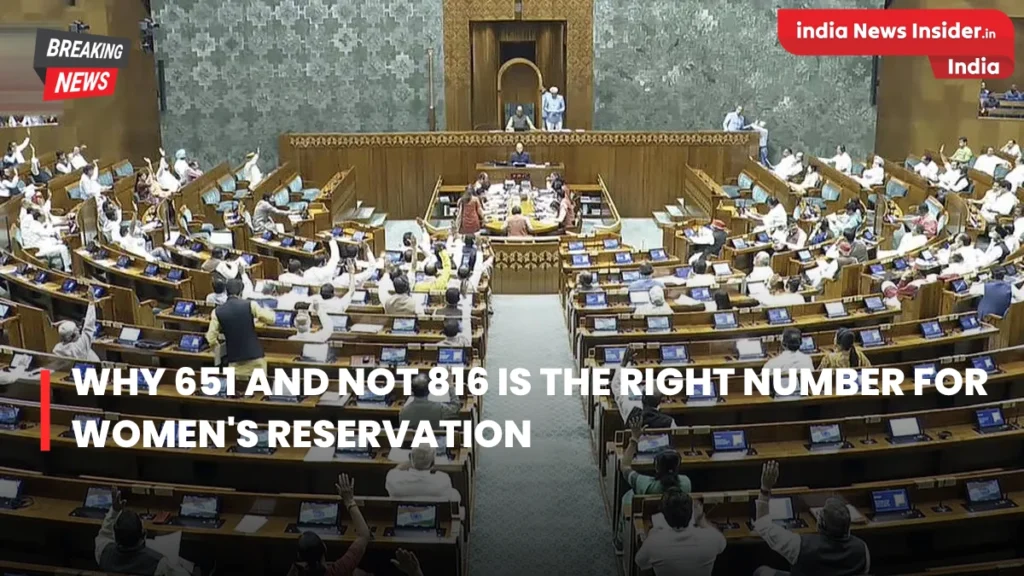
The Union government’s recent suggestion to expand the Lok Sabha by 50 per cent, increasing the total number of seats from 543 to 816, has sparked considerable debate. This proposal, intended to implement the women’s reservation Bill without displacing current Lok Sabha members, implies that 272 out of 816 seats would ensure one-third representation for women. However, this article argues that such a significant expansion is unwieldy and unnecessary.
Read also: India’s Parliament Debates Landmark Women’s Quota Amidst Redrawing of Voting Boundaries
Instead, we propose an alternative model that achieves fair implementation of women’s reservation in the Lok Sabha (and, by extension, State Legislative Assemblies) with a more manageable and justified increase to 651 seats. This approach, using a hybrid electoral system, is not only less cumbersome but also offers a more precise and equitable outcome, thus making a strong case for 651 and not 816 is the right number.
The Challenge of Implementing Women’s Reservation Within 543 Seats
If the Lok Sabha’s strength were to remain frozen at 543 seats, as suggested by Tamil Nadu Chief Minister M.K. Stalin, women’s reservation would have to come from within the existing seats. While seemingly straightforward, this path presents several significant challenges:
Rotational Reservation of Constituencies
This method, where approximately 181 constituencies (one-third of 543) are reserved for women and rotate each election cycle, is currently used for panchayats and urban local bodies. However, at the parliamentary level, it carries substantial risks. It can interrupt the continuity of incumbents, potentially affecting their commitment to their constituencies and reducing accountability. It may also generate resentment against women replacing male incumbents.
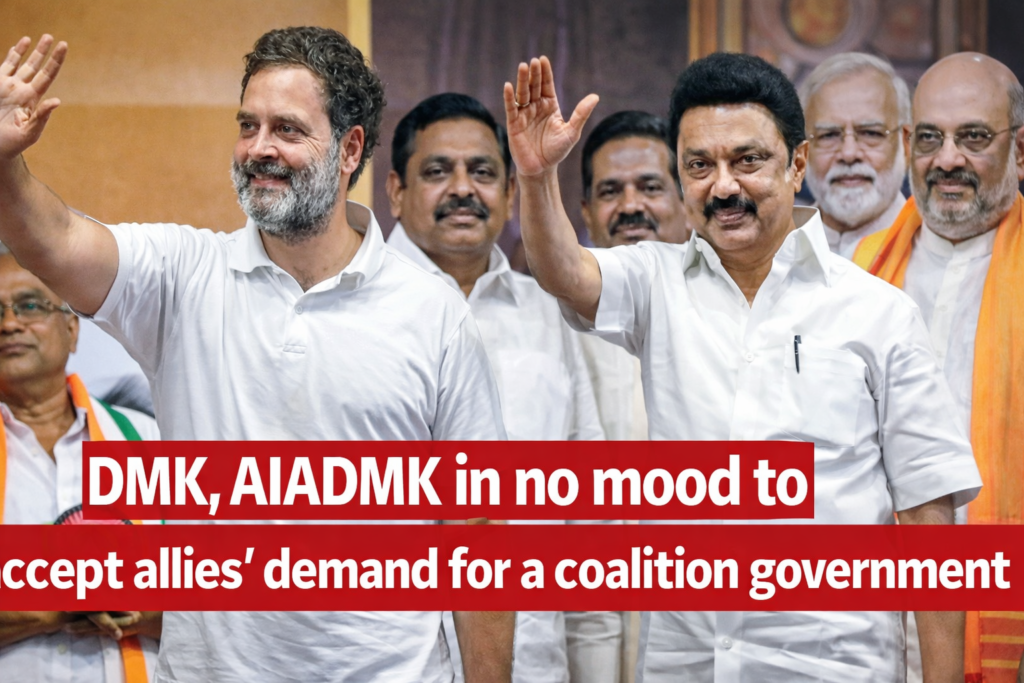
Read also: DMK, AIADMK in no mood to accept allies’ demand for a coalition government
Dual-Member Constituencies
Introducing dual-member constituencies, where some seats elect two MPs instead of one, would necessitate a complex redesign of the entire electoral system. The primary drawback is the unequal representation it creates, with some constituencies having two representatives while others have only one.
Party-Level Candidate Quotas
Mandating political parties to field at least 33 per cent women candidates across constituencies, similar to Pakistan’s model, could encourage systemic change within party structures. However, this method cannot guarantee 33 per cent women MPs, as the outcome remains dependent on election results, not merely candidate selection.
Proportional “Top-Up” Seats (within 543)
This approach involves adjusting seats internally after elections. If, for instance, women’s representation falls short of 33 per cent (currently around 14-15 per cent), additional seats could be reallocated via party lists or nomination. However, this would fundamentally complicate India’s existing first-past-the-post (FPTP) system, raising constitutional and legitimacy concerns.
Given these issues, implementing women’s reservation effectively while maintaining the Lok Sabha’s strength at 543 seats poses serious practical and constitutional problems.
The Advantages of Proportional Representation in Achieving Gender Quotas
A more effective variant for implementing women’s reservation involves a modest increase in the Lok Sabha’s size, coupled with a system of proportional representation (PR) to supplement, rather than supplant, the existing FPTP system. This hybrid approach is easier, more precise, and ensures fairness.
In a proportional representation system, parties submit ranked candidate lists, and seats are allocated based on their vote share. This mechanism allows for built-in gender balancing. We propose a mandatory “1/3 women in party lists” rule, ensuring that at least 33 per cent of candidates on party lists are women. Since PR allocates seats directly from these lists, this translates precisely into the desired number of seats for women.
The benefits of relying primarily on proportional representation are manifold:
- Guaranteed Outcome: It ensures exactly 33 per cent or more women MPs without blocking male candidates from specific constituencies.
- Systematic Promotion: It incentivizes parties to systematically promote women within their ranks.
- Fairer Representation: PR ensures a better reflection of vote share in seat share, a significant improvement over the FPTP system, which often distorts electoral outcomes. For example, in the 2014 general election, the BJP’s vote share was ~31 per cent but its seat share was ~52 per cent. Similarly, in the 2017 Uttar Pradesh Assembly Election, the BJP secured ~77 per cent of seats with only ~39.7 per cent of votes.
Globally, the FPTP system, though adopted by India at Independence, is now a minority system (~25 per cent of countries). Proportional representation dominates (~40 per cent and rising), while mixed systems (FPTP + PR) are increasingly popular (~20 per cent). While PR might, to some extent, weaken the constituency link and grant party leadership greater power, its value lies in achieving women’s representation without disrupting the entire system, while simultaneously ensuring greater fairness in vote-to-seat translation.
Why 651 and Not 816 is the Right Number for an Expanded Lok Sabha
The Union government’s suggestion to expand the Lok Sabha to 816 seats lacks a clear justification. Such a large legislative body would resemble a political rally rather than a deliberative parliament. For effective debate and governance, a manageable size is crucial. For context, the UK’s lower house of parliament, one of the largest globally, has 650 members. Therefore, this article makes a strong case for 651 and not 816 is the right number for an expanded Lok Sabha.
We propose an increase to 651 seats. This expansion is justified by India’s significant population growth since the 1971 delimitation freeze. This number ensures that the Lok Sabha can accommodate 216 women MPs, precisely 33 per cent of 651.
How the FPTP + Proportional Reservation System Will Work with 651 Seats:
- Total Women MPs: With 651 seats, 216 women MPs would constitute 33 per cent.
- Hybrid Election:
- Half of these women (108) would be elected through the existing first-past-the-post system from within the current 543 constituencies.
- The remaining half (108) would be elected via proportional reservation from newly added seats. The difference between the proposed total (651) and the current total (543) is exactly 108 seats. These 108 new seats would be reserved for women elected through party lists under proportional representation.
- Federal Approach: To ensure federal balance, party lists for women under the proportional reservation system would ideally be at the State level, making the process more acceptable and reflective of regional diversity.
Implementation Requirements:
- Constitutional Amendment: Article 81 (Composition of Lok Sabha) would need to be amended to increase the cap from 543 to 651 seats.
- Electoral Law Modification: The Representation of the People Act would require modifications to explicitly allow a mixed electoral system (FPTP + proportional reservation), including State-level proportional allocation, linked with the Women’s Reservation Bill.
- Dual Voting System: Voters could be given two votes: a Constituency vote (for FPTP) and a Party vote (for proportional reservation seats). Parties would submit State-wise ranked lists of women candidates for the Party vote.
- No Redrawing for FPTP Women Seats: Delimitation would not be required to redraw constituencies for the 108 FPTP women’s seats, as they would operate within the existing structure.
Integrating SC/ST Reservation:
It is crucial that Scheduled Castes (SC) and Scheduled Tribes (ST) reservation also applies to the proportional reservation portion of the Lok Sabha to prevent a drop in their overall share. There are two primary ways to integrate SC/ST and women’s reservation:
- Parallel Quotas: This simpler method involves non-overlapping quotas, ensuring SC/ST representation remains unchanged without requiring sub-quotas.
- Nested Quotas: This more socially balanced approach ensures representation of SC women (~28 seats) and ST women (~16 seats) within their respective totals. Under this model, parties would submit three distinct lists: a general women list, an SC women list, and an ST women list.
The legal framework for this hybrid system would need careful alignment with the Constitution and Election Commission rules. This approach, centered around 651 seats, provides a practical, fair, and constitutionally sound method for implementing women’s reservation without creating an unmanageably large parliament, thus demonstrating why 651 and not 816 is the right number.
Conclusion
The debate around women’s reservation in the Lok Sabha presents an opportunity to modernize India’s electoral system. While the aspiration to achieve 33 per cent women’s representation is commendable, the proposed expansion to 816 seats is excessive and impractical. The alternative methods within the existing 543 seats are fraught with difficulties.
This article has demonstrated why an expansion to 651 seats, coupled with a carefully designed hybrid system of first-past-the-post and proportional representation, is the optimal solution. This model ensures precise women’s representation, fosters systemic change within political parties, and addresses the distortions inherent in the current FPTP system, all while maintaining a manageable parliamentary size conducive to effective debate. Political leaders, particularly from opposition parties, should consider these proposals in the national interest, embracing an approach where 651 and not 816 is the right number for a stronger, more representative Indian Parliament.
Read More
- NDTV India is Hindi News Website. Read Hindi News, Latest Hindi News, Today Hindi News, Breaking Hindi News, Hindi Samachar
- Today’s news: Get latest and Breaking News on Politics, Business, Lifestyle, Entertainment and Sports along with News updates from around the world.
- Read the Latest News Updates online related to India, World and US business and economy.
- Times of India: News – Breaking News, Latest News, India.
- ભારતની તમામ નવી સરકારી યોજનાઓ 2026 વિશે માહિતી