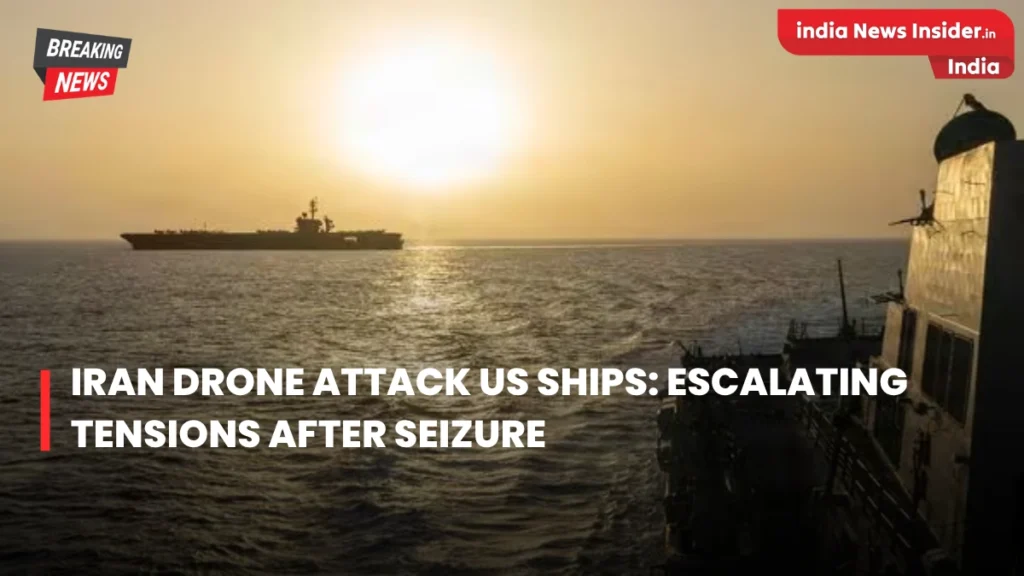
The volatile relationship between the United States and Iran has taken a dangerous turn, with reports of an Iran Drone Attack US Ships following a controversial U.S. naval operation. This development marks a significant escalation in the ongoing regional standoff, coming shortly after the U.S. forcibly seized an Iranian-flagged cargo ship in the vicinity of the strategic Strait of Hormuz.
Join our social media platform
The Catalyst: US Seizes Iranian Cargo Ship
The latest flashpoint began when U.S. President Donald Trump confirmed that American forces had intercepted and seized the Iranian-flagged cargo vessel, Touska, on Sunday. The action, described by the U.S. as a move to enforce a naval blockade near the Strait of Hormuz, involved a U.S. Navy guided missile destroyer in the Gulf of Oman. Trump stated that the destroyer “stopped them right in their tracks by blowing a hole in the engineroom,” with U.S. Marines subsequently boarding the vessel to inspect its contents. This incident directly led to a heightened state of alert, culminating in the reported Iran Drone Attack US Ships.
Read also: Trump Raises Stakes Ahead of Peace Talks With Iran: “We May Drop Bombs Again”
Iran’s Swift Condemnation and Warning of Retaliation
Tehran swiftly condemned the U.S. action, accusing Washington of violating a ceasefire that had been in place since early April. Iran’s top diplomat, Abbas Araghchi, reportedly conveyed to his Pakistani counterpart, Ishaq Dar, that the U.S. demands in negotiations and threats against Iranian vessels and ports were “clear signs” of America’s insincerity. Conflicting accounts of the incident emerged, with Iran labeling the seizure an act of “maritime piracy” and issuing a stern warning of retaliation. The subsequent Iran Drone Attack US Ships appears to be the fulfillment of that warning.
Read also: Strait of Hormuz Declared Open Amid Hopes for Broader Mideast Peace
Economic Repercussions and Diplomatic Stagnation
The escalating tensions immediately reverberated through global markets. Benchmark U.S. crude, West Texas Intermediate (WTI), surged by 7.5% to $90.17 per barrel on Monday, while the global benchmark, Brent crude, rose 6.5% to $96.27 per barrel. These jumps underscore the market’s anxiety over potential disruptions to oil supplies from the critical Middle East region.
Amidst the rising hostility, President Trump mentioned that U.S. negotiators would head to Pakistan on Monday for more talks with Iran. However, neither Iran nor Pakistan has confirmed any such diplomatic engagement, casting a shadow of uncertainty over any immediate de-escalation efforts. The lack of confirmation further highlights the diplomatic impasse, leaving the door open for further escalations like the reported Iran Drone Attack US Ships.
Conclusion
The seizure of the Touska and the subsequent Iran Drone Attack US Ships represent a dangerous escalation in the long-standing animosity between the U.S. and Iran. With both sides offering starkly different narratives and crude oil prices soaring, the path forward appears fraught with peril. The international community watches closely as the region grapples with the potential for wider conflict, underscoring the urgent need for confirmed diplomatic channels to avert further confrontation.
Read More
- NDTV India is Hindi News Website. Read Hindi News, Latest Hindi News, Today Hindi News, Breaking Hindi News, Hindi Samachar
- Today’s news: Get latest and Breaking News on Politics, Business, Lifestyle, Entertainment and Sports along with News updates from around the world.
- Read the Latest News Updates online related to India, World and US business and economy.
- Times of India: News – Breaking News, Latest News, India.
- ભારતની તમામ નવી સરકારી યોજનાઓ 2026 વિશે માહિતી