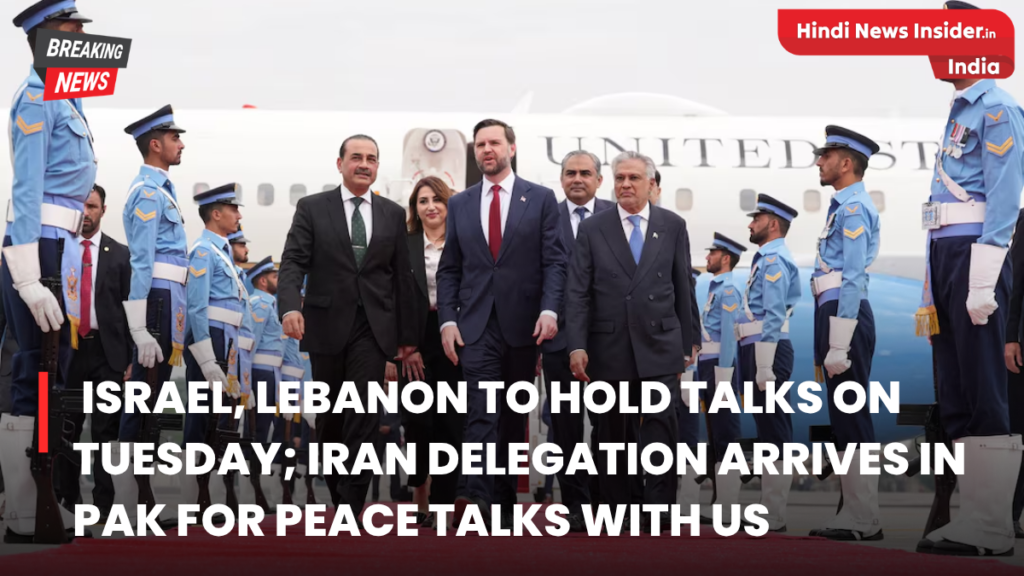
Iran-US Peace Talks: The geopolitical landscape of the Middle East is currently a mosaic of high-stakes diplomacy and simmering conflict. At the forefront of these complex dynamics are the eagerly anticipated Iran-US Peace Talks in Pakistan, a development that carries immense weight for regional stability. Simultaneously, a separate but equally crucial dialogue is set to unfold as Israel and Lebanon prepare for talks, underscoring a broader push, albeit fragile, toward de-escalation in a volatile region. These parallel diplomatic efforts highlight a critical juncture where the potential for breakthroughs is as palpable as the risks of further destabilization.
Join our social media platform
The upcoming discussions represent a delicate dance between long-standing adversaries, mediated by a third party, and overshadowed by recent violent flare-ups. The world watches with bated breath, understanding that the outcomes of these negotiations could redraw the contours of power and peace in one of the globe’s most strategically vital areas.
A Pivotal Moment for Regional Stability: The Iran-US Peace Talks
The diplomatic stage is set in Islamabad, Pakistan, for what could be a landmark series of discussions between Iran and the United States. These Iran-US Peace Talks are designed to put a definitive end to the intense fighting that has plagued the Middle East since late February, bringing a much-needed two-week pause to hostilities. Pakistan has commendably stepped into the role of mediator, attempting to bridge the deep chasm of distrust and animosity that has historically defined relations between Tehran and Washington.
Read also: Lebanon Confirms Attendance at Washington Ceasefire Talks
High Stakes in Islamabad: Delegations and Expectations
The arrival of the Iranian delegation in Pakistan has been a subject of considerable confusion and conflicting reports, underscoring the inherent fragility of the current peace process. Initially, reports indicated that a high-profile delegation, led by Parliament Speaker Mohammad Baqer Qalibaf and accompanied by Foreign Minister Abbas Araghchi and other key leaders, had arrived in Islamabad late Friday night for the Iran-US Peace Talks. This news sparked optimism for the impending negotiations.
However, this optimism was quickly tempered by several Iranian news outlets, including Mehr news agency, Tasnim, and Fars news, which vehemently rejected reports from sources like the Wall Street Journal. These outlets claimed that neither Foreign Minister Abbas Araghchi nor Parliament Speaker Mohammad Bagher Ghalibaf had yet departed for Islamabad, casting a shadow of uncertainty over the scheduled discussions. Such discrepancies highlight the intricate web of political maneuvering and information control that often surrounds high-level international diplomacy, especially when it involves such deeply entrenched rivals.
On the American side, Vice President JD Vance has already departed for Islamabad, expressing a guarded optimism about the forthcoming negotiations. Vance noted that US President Donald Trump has laid out clear guidelines for the discussions, emphasizing the administration’s willingness to engage in good faith. However, he also issued a stark warning to Tehran, cautioning against any attempts to “play” the United States. “If the Iranians are willing to negotiate in good faith, we’re certainly willing to extend the open hand. If they’re going to try to play us, then they’re going to find the negotiating team is not that receptive,” Vance stated.
This firm stance indicates that while Washington is open to dialogue, it is also prepared to maintain a tough negotiating position. The US delegation is expected to be led by Vice President Vance, and will reportedly include President Donald Trump’s top envoy Steve Witkoff and son-in-law Jared Kushner, signaling the high importance the US administration places on these Iran-US Peace Talks.
Pakistan, as the host and mediator, has taken extensive measures to ensure the security and smooth conduct of the talks. Security has been significantly beefed up around the talks venue in Islamabad, which is strategically located in the vicinity of a high-security zone housing key government buildings and embassies. The Serena Hotel, reportedly requisitioned from Wednesday evening through Sunday, has been vacated to accommodate the delegations, as reported by Al Jazeera. This meticulous preparation by Pakistan underscores its commitment to fostering a conducive environment for these critical Iran-US Peace Talks.
Read also: “Crushing Victory”: Iran Declares “DEFEAT” Of Israel & U.S. After Trump Retreat, Truce Announcement
The Shaky Foundations of a Ceasefire
The current diplomatic push for Iran-US Peace Talks operates on a fragile ceasefire, an agreement reached earlier this week that brought a temporary halt to the intense military engagements in the Middle East. However, the stability of this truce has been severely tested by several recent incidents, casting doubt on its longevity and the prospects for lasting peace.
One of the most significant destabilizing factors has been Israel’s deadly strikes on neighboring Lebanon. These attacks resulted in a devastating toll of around 300 dead and nearly a thousand injured, injecting a fresh wave of violence and regional instability into an already tense environment.
The timing of these strikes, amidst preparations for crucial peace discussions, has understandably triggered uncertainty over the broader peace process. Such events underscore how interconnected the conflicts in the Middle East are, and how actions in one theater can have immediate and profound repercussions on diplomatic efforts elsewhere. The shadow of these casualties looms large over any attempts to forge a lasting peace.
Further complicating the situation, Kuwait has accused Iran and its proxies of launching drone attacks targeting its territory on Thursday, despite the agreed-upon truce between Iran and the US. Similarly, Saudi Arabia reported that its key East-West pipeline was damaged in recent attacks. This pipeline is crucial as it carries oil to the Red Sea, bypassing the Strait of Hormuz.
These accusations, if proven, suggest a continued pattern of regional proxy conflicts and aggressive actions that directly undermine the spirit and letter of any ceasefire. Such incidents not only risk reigniting broader hostilities but also erode the trust necessary for successful Iran-US Peace Talks. The international community remains vigilant, monitoring these developments closely for any signs that could derail the fragile peace.
The Strait of Hormuz: A Persistent Point of Contention
Adding another layer of complexity to the already intricate discussions, the Strait of Hormuz has re-emerged as a significant flashpoint. This vital waterway, through which approximately 20 percent of the world’s oil passes, has long been a strategic chokehold that Iran maintains a strong influence over. Recent reports suggesting that Iran may levy fees from vessels navigating the Strait of Hormuz drew an immediate and strong reaction from US President Donald Trump.
In a post on Truth Social, President Trump issued a stern warning to Tehran: “There are reports that Iran is charging fees to tankers going through the Hormuz Strait — They better not be and, if they are, they better stop now!” These remarks highlight the extreme sensitivity surrounding the free passage through the Strait, which is critical for global energy security and international trade. Any attempt by Iran to impose tolls would be viewed as an escalation and a direct challenge to international maritime law, potentially triggering a severe response and further jeopardizing the Iran-US Peace Talks.
The issue of Hormuz underscores the deep-seated economic and strategic rivalries that continue to fuel tensions in the region. While the ceasefire aimed to halt direct military confrontations, the underlying issues of geopolitical influence, economic leverage, and access to vital resources remain unresolved. The outcome of the Iran-US Peace Talks will undoubtedly need to address these fundamental points of contention to ensure any agreement has a chance of enduring.
Israel-Lebanon Dialogue: A Separate Path to De-escalation
Amidst the swirling currents of US-Iran diplomacy, another critical development is taking shape: Israel and Lebanon are set to hold talks on Tuesday. While distinct from the Iran-US Peace Talks, this bilateral dialogue is intrinsically linked to the broader efforts to foster stability in the Middle East. The commitment to dialogue, even in the shadow of recent violence, signals a potential, albeit cautious, step towards de-escalation between two nations with a long history of conflict.
Unveiling the Agenda for Bilateral Discussions
The decision by Israel and Lebanon to engage in direct talks comes in the immediate aftermath of devastating Israeli strikes on Lebanon, which left a tragic human toll. This context makes the scheduled discussions particularly poignant and urgent. While the specific agenda for these talks has not been extensively detailed, it is expected to focus on easing border tensions, addressing security concerns, and potentially exploring mechanisms for conflict resolution. The very act of sitting down at the negotiating table, despite recent hostilities, is a significant diplomatic achievement in itself.
For Lebanon, the talks represent an opportunity to address the humanitarian crisis and seek assurances against further military incursions. For Israel, they offer a chance to secure its northern border and potentially curb the influence of non-state actors operating near its territory.
The mere prospect of such high-level engagement between these two historical adversaries suggests a recognition of the imperative to prevent further escalation and to explore diplomatic avenues to manage their long-standing disputes. The success or failure of these talks could have localized impacts but also broader regional implications, influencing the overall climate for peace.
Navigating Deep-Rooted Historical Complexities
The relationship between Israel and Lebanon is characterized by decades of conflict, proxy wars, and deep-seated animosity. From the Lebanese Civil War to numerous cross-border skirmishes and full-scale wars, the history is fraught with distrust and violence. This makes any attempt at dialogue inherently challenging, requiring immense political will and a pragmatic approach from both sides.
Past attempts at peace or even de-escalation have often faltered due to a myriad of factors, including internal political divisions within Lebanon, the influence of regional powers, and the presence of armed groups. However, the current impetus for talks, especially after such a destructive period, might signal a renewed understanding of the costs of continued conflict. Potential breakthroughs could involve agreements on maritime or land borders, security arrangements, or even humanitarian cooperation.
The path will be arduous, but the sheer necessity of preventing further loss of life and fostering a semblance of stability provides a powerful motivation for both parties to engage constructively. These discussions, while separate, contribute to the larger narrative of diplomatic engagement that includes the Iran-US Peace Talks.
Global Implications of Middle East Diplomacy
The diplomatic endeavors unfolding in Pakistan and between Israel and Lebanon are not confined to the immediate region. The Middle East’s strategic importance, particularly its role in global energy markets and its geopolitical fault lines, means that these peace efforts carry significant global implications, affecting economies, international relations, and security worldwide.
Economic Repercussions and Energy Security
The stability of the Middle East is inextricably linked to global energy security. The Strait of Hormuz, central to the Iran-US Peace Talks, is a prime example. Any disruption to its free passage, whether through conflict or the imposition of tolls, sends immediate shockwaves through international oil markets, leading to price volatility and economic uncertainty.
President Trump’s strong warning regarding potential Iranian tolls underscores the global economic stakes involved. Nations heavily reliant on oil imports, particularly in Asia and Europe, closely monitor developments in Hormuz, understanding that their economic well-being is directly tied to the security of this waterway.
Furthermore, the recent attack on Saudi Arabia’s East-West pipeline, which carries oil out to the Red Sea and bypasses the Strait of Hormuz, highlights the vulnerabilities of alternative energy routes. Damage to such critical infrastructure not only affects Saudi Arabia’s oil export capabilities but also raises concerns about the resilience of global energy supply chains. The ongoing discussions, particularly the Iran-US Peace Talks, are therefore crucial for mitigating these economic risks and ensuring a stable global energy landscape.
The Role of International Mediation and Superpower Influence
The current diplomatic landscape also illuminates the vital role of international mediation and the influence of global superpowers. Pakistan’s proactive role in brokering the truce and hosting the Iran-US Peace Talks demonstrates the potential for regional powers to facilitate dialogue between larger, often antagonistic, states. Such mediation efforts are indispensable in de-escalating conflicts and creating platforms for peaceful resolution.
The United States, as a superpower, exerts significant influence over the dynamics of the Middle East. President Trump’s clear guidelines for negotiations and Vice President Vance’s direct warnings to Iran underscore the US’s firm stance and its desire to shape the outcomes of these talks. The inclusion of top US envoys and family members in the delegation signals the high priority Washington places on achieving a favorable resolution. The success of these diplomatic initiatives hinges not only on the willingness of the direct parties to negotiate but also on the sustained commitment and strategic leverage of mediating and influential global actors.
The Path Forward: Challenges and Opportunities for Lasting Peace
The ongoing diplomatic efforts, particularly the Iran-US Peace Talks and the Israel-Lebanon dialogue, represent a critical juncture for the Middle East. While fraught with challenges stemming from historical grievances, recent hostilities, and deep-seated distrust, they also present a rare opportunity to forge a more stable and peaceful future for the region.
Addressing Core Grievances and Building Trust
For any peace agreement to be sustainable, it must address the core grievances that fuel conflict. In the context of the Iran-US Peace Talks, this includes issues ranging from Iran’s nuclear program and regional influence to US sanctions and military presence. For Israel and Lebanon, it involves resolving border disputes and security concerns.
Genuine and lasting peace requires more than just a cessation of hostilities; it demands a willingness from all parties to engage in good faith, acknowledge past wrongs, and work towards mutually agreeable solutions. Building trust, a commodity often scarce in this region, will be paramount. This involves transparent communication, verifiable commitments, and consistent adherence to agreed-upon terms. Without these fundamental elements, any peace will remain tenuous.
Monitoring and Sustaining Ceasefires
The fragility of the current ceasefire, as evidenced by recent accusations and attacks even amidst the diplomatic push, underscores the immense challenge of sustaining peace. Effective monitoring mechanisms will be essential to ensure compliance with any agreements reached during the Iran-US Peace Talks or between Israel and Lebanon.
This includes international observers, clear channels for reporting violations, and agreed-upon consequences for non-compliance. The risk of proxy conflicts and the actions of non-state actors undermining peace efforts remains high.
Therefore, any comprehensive peace framework must also consider strategies to manage and mitigate these external pressures, ensuring that diplomatic gains are not swiftly undone by continued low-level conflict. The road to lasting peace is long and arduous, but the current diplomatic initiatives offer a glimmer of hope that, with sustained effort and genuine commitment, a more stable future for the Middle East might yet be within reach.
Conclusion
The convergence of the Iran-US Peace Talks in Pakistan and the impending dialogue between Israel and Lebanon paints a complex but cautiously optimistic picture of diplomacy in the Middle East. While the path to peace is undeniably fraught with challenges, marked by conflicting reports, lingering resentments, and the shadow of recent violence, these diplomatic endeavors signify a critical shift towards dialogue over confrontation.
The world watches, understanding that the outcomes of these high-stakes negotiations will profoundly influence not only the immediate fate of the region but also global economic stability and international relations for years to come. The hope, however fragile, is that through determined negotiation and genuine commitment, a more stable and prosperous future can emerge from the current state of tension.
Read More
- NDTV India is Hindi News Website. Read Hindi News, Latest Hindi News, Today Hindi News, Breaking Hindi News, Hindi Samachar
- Today’s news: Get latest and Breaking News on Politics, Business, Lifestyle, Entertainment and Sports along with News updates from around the world.
- Read the Latest News Updates online related to India, World and US business and economy.
- Times of India: News – Breaking News, Latest News, India.
- ભારતની તમામ નવી સરકારી યોજનાઓ 2026 વિશે માહિતી